Introduction
If you rent out property in Colorado, you have probably heard of Colorado tenant screening HB23-1099 and quietly hoped it did not apply to you. It does, and here is the part nobody tells you first: it is good for you. The short version is that, in almost every case, you have to accept a portable, reusable screening report instead of forcing every applicant to buy a fresh one from you. I am a landlord and a licensed Colorado agent, and when I read the law the first time I braced for a headache. What I found was a faster way to fill units. Let me walk you through it the way I would explain it to another landlord over coffee.
What HB23-1099 Actually Requires
Let me strip out the legal language. HB23-1099 says that if a prospective tenant already has a recent screening report they are willing to share, you have to accept it rather than making them pay again for one you order yourself.
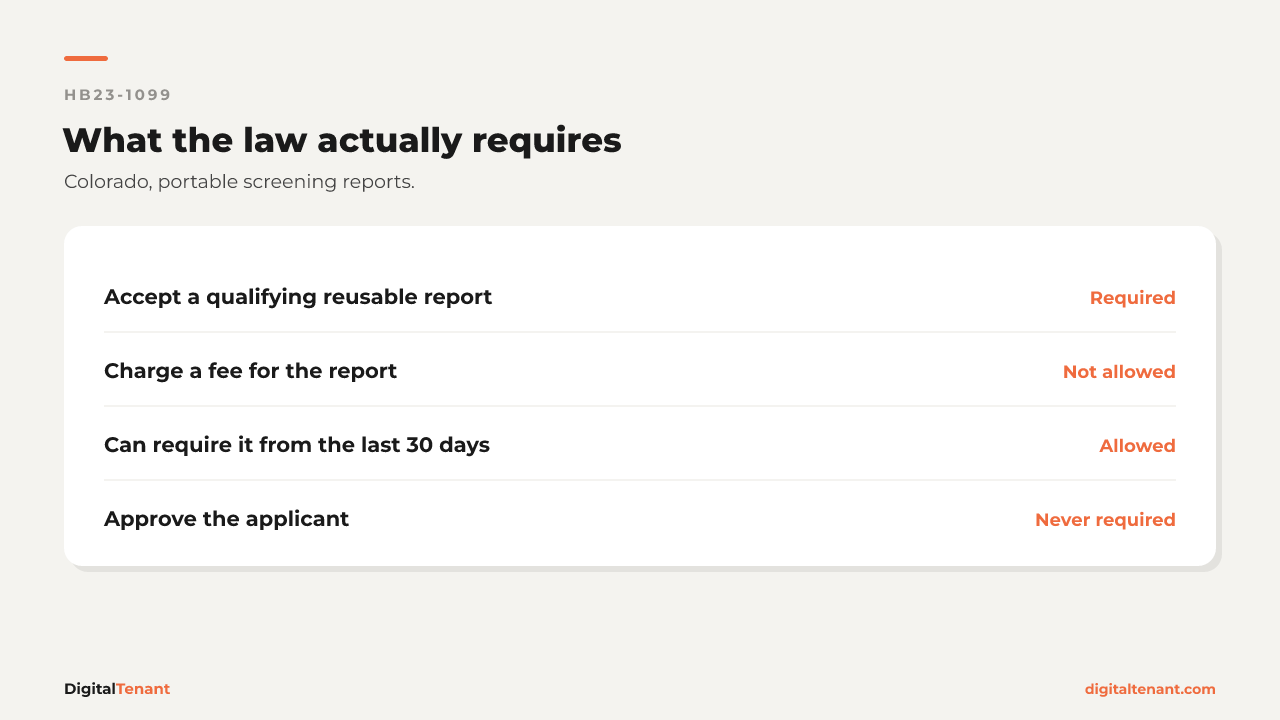
There is one exemption. If you only take one application fee at a time for a unit, and you refund it in full within 20 calendar days after either you or the applicant declines the lease in writing, you don't have to accept portable reports. In practice that means screening applicants one by one while the unit sits empty, which is why most landlords accept them.
The report has to be a consumer report the applicant asked for, with information from a consumer reporting agency. The statute lists what it must include: name, contact information, verification of employment and income, last-known address, rental and credit history, and criminal history, plus the date the information is current through. You can require that it was completed within the previous 30 days. If it checks those boxes, you take it. You cannot charge that applicant an application fee, or any fee to access or use the report.
You also have to tell applicants up front. Before you take any screening step you would normally charge an application fee for, let them know they have the right to give you a portable report, and that if they do, you cannot charge them an application fee or a fee to access or use it. The statute says to put this where applicants will see it, like your listing, your website's home page, or the application itself, generally in at least 12-point bold type. You can also tell them directly and get written confirmation they received it.
That is the whole spine of the law. Accept a valid portable report. Do not double-charge for screening you did not need to run.
Why the old way was quietly costing you
Think about how screening usually worked. A strong applicant finds four listings they like. Each landlord charges $50 to $60 to apply. That is $200 to $240 out of pocket before anyone has signed anything.
So what does the good applicant do? Sometimes they pick two out of the four and skip yours. Sometimes they stall, wait, and lose the unit to someone faster. You did not lose that applicant on price or on the property. You lost them on a screening fee. HB23-1099 exists to stop that, and the side effect is that your applicant pool gets bigger.
What Changed in 2026: HB25-1236
Colorado adjusted the rules with HB25-1236, signed June 3, 2025. It took effect January 1, 2026, and applies to rental applications submitted on or after that date. Two changes matter for you.
First, you can no longer require that the report come to you directly from the screening company or through a third-party screening website. That option was repealed. If an applicant sends you a qualifying report themselves, you still have to accept it. You can still require that it was completed within the last 30 days, that it costs you nothing to access or use, and that the applicant gives you a statement that nothing material has changed.
Second, if an applicant is renting with the help of a housing subsidy, their portable report does not have to include a credit history report, a credit score, or adverse credit events. So don't treat a subsidy applicant's report as incomplete because the credit piece is missing.
This is general information, not legal advice. Read the current statute (Colorado Revised Statutes 38-12-902 and 38-12-904) or talk to a Colorado attorney about your situation.
Why a Portable Report Helps You, Not Just the Tenant
I want to be honest about the framing here, because most write-ups on this law lead with the tenant's savings. Fine, tenants save money. But you are running a business, so let me tell you what you get.
You fill units faster
A portable report means a qualified applicant can apply to your unit today, right now, without pausing to pay another fee or wait on another report. Less friction between "I love this place" and "here is my file." Vacancy is the most expensive thing you own. Every day a unit sits empty costs more than any application fee ever brought in.
You get a bigger, better applicant pool
The applicants most likely to shop several units at once are the strong ones. Good credit, steady income, nothing to hide. Those are exactly the people who used to skip listings to avoid stacking fees. When you accept a portable report, you stop filtering out your best prospects by accident.
A strong applicant does not ghost you over $55
This is the one I feel personally. I have watched a great applicant go quiet because they had already spent their screening budget elsewhere. A $55 fee should never cost you a qualified tenant. With a portable report, it does not.
How to Accept a Portable Report Cleanly
Compliance sounds scary until you break it into steps. Here is the framework I use so I know a report is solid before I rely on it.
1. Confirm the report is current and complete
Check the date first. A screening report is a snapshot, so you want a recent one. In Colorado you can require one completed within the previous 30 days. Then confirm it actually contains what you screen for. Not a credit score sitting alone with nothing behind it.
2. Verify the core three: credit, background, eviction
These are the non-negotiables. You want a real credit report, a criminal background check, and an eviction history. On DigitalTenant these run on TransUnion, so the credit, background, and eviction data is the same source the big screeners use. When a report is built on TransUnion, you are not guessing about where the numbers came from.
3. Verify identity and income
A file is only as good as the person it belongs to. You want identity confirmed and income verified, not just a pay stub someone typed up. On a Tenant Passport, pay stubs are checked for tampering through Plaid, so you are not taking a document that could be edited in five minutes at face value.
4. Keep your standards consistent
HB23-1099 does not force you to lower your bar. You still set your own criteria for credit, income, and history. It just says apply that bar to the portable report the applicant hands you, the same way you would to one you ordered. Consistency is your friend here, both for fairness and for staying clean under fair-housing rules. Whatever standard you use for Jordan Avery at 123 Main St, use it for everyone.
The Cleaner Way: DigitalTenant and the Tenant Passport
Here is where I will show you the tool I built, because HB23-1099 is basically the world this product was made for.
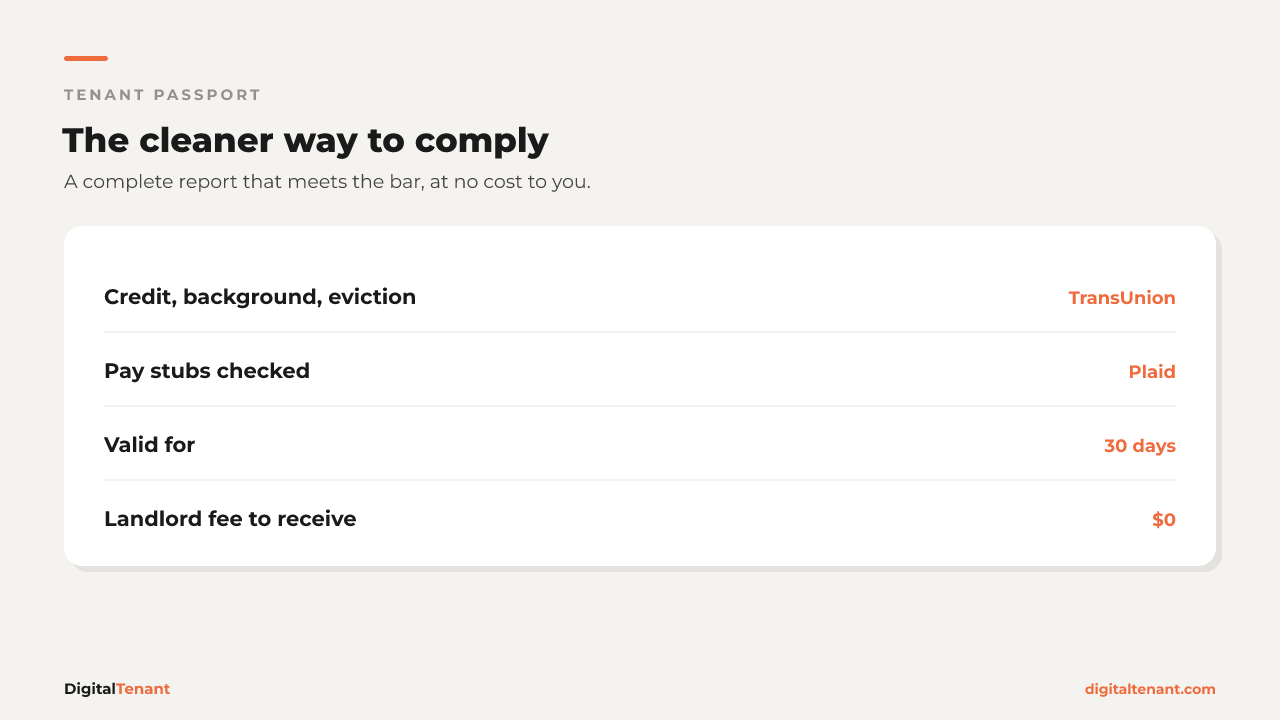
The Tenant Passport is a portable, verified screening report the applicant creates and pays for themselves. It is standardized, so every one you receive looks the same and covers the same ground. And this is the part landlords double-check with me every time: you pay nothing to receive or view a Passport. The tenant pays for their own screening. You read the file for free. That is the mechanism the law is built around, done cleanly.
What is inside a Passport
A Passport carries the core three on TransUnion, credit, background, and eviction, plus pay stubs checked for tampering through Plaid. Then it goes further than standard portable screening. It adds employment verification, rental history, basic screening questions, and supporting income documentation. So the portable report you accept is often more complete than the one you used to run yourself. You can see how this looks from the landlord side on our landlord screening page.
It works the same in every state
Colorado made accepting portable screening reports the law, but nothing about the logic is Colorado-only. Reusing one solid, verified screening report is faster and fairer for landlords everywhere. If you rent in a state that has not passed a law like HB23-1099 yet, you can still accept a Passport by choice and get the same faster fills. Tenants can build one on the Tenant Passport page, and it works whether your units are in Denver or anywhere else in the country.
Key Takeaways
- Colorado tenant screening HB23-1099 requires most landlords to accept a valid portable screening report and not double-charge an applicant for a duplicate.
- The law helps you, not just the tenant. Faster fills, a bigger applicant pool, and no more losing strong applicants over a $55 fee.
- To accept a report cleanly, confirm it is current and check the core three (credit, background, eviction) plus identity and income.
- The Tenant Passport is a purpose-built portable report on TransUnion and Plaid, and landlords pay $0 to receive or view it. The tenant pays for their own screening.
- The product is nationwide. Colorado made it the law, but the case for reusing one solid screening applies in every state.
Next Steps
- Read the actual text of HB23-1099 once so you know your obligations firsthand.
- Write down your screening standard for credit, income, and history so you apply it consistently to every report.
- Add a line to your listings that you accept a Tenant Passport, so strong applicants apply without a fee delay.
- Review the pricing guide to see where a landlord plan fits your unit count.
- Try DigitalTenant Free and accept your first portable report the clean way.
About the Author
Pierre Elize, Founder of DigitalTenant. Property Management. Tenant Screening. One Platform.