Introduction
Most landlord disputes I have watched blow up did not start with a bad tenant. They started with a vague lease. When you know what to include in a rental lease agreement and you actually write it down, most fights never happen, because the answer is already on the page. I have run my own rentals for years as a landlord and a licensed agent, and the leases that saved me were never the fancy ones. They were the clear ones. A generic template you pulled off the internet at midnight feels fine on move-in day. It bites you the day something goes wrong and the document does not cover it.
This is a practical checklist of what belongs in a solid lease. Laws vary by state, and this is not legal advice, so check your local rules or a local attorney before you sign anything. But the bones below travel well.
Why a Weak Lease Bites You Later
A lease is not paperwork. It is the rulebook you agreed to before anyone had a reason to argue. When the rulebook is thin, every disagreement becomes your word against theirs.
Say Jordan Avery at 123 Main St stops paying on time. If your lease never spelled out the due date, the grace period, and the late fee, you are now negotiating from scratch while you are already out the money. Say a pipe bursts and the tenant wants a hotel reimbursed. If the lease never assigned maintenance responsibility or defined how repairs get handled, you are guessing. Say three extra people move in over the summer. If occupancy was never capped, you have no clean footing to stand on.
A vague lease shifts every gray area in the tenant's favor, because you are the one who has to prove what was meant. A specific lease does the opposite. It answers the question before the question gets asked. That is the whole point of knowing what to include in a rental lease agreement up front, instead of finding the holes after they cost you.
What to Include in a Rental Lease Agreement: The Clause Checklist
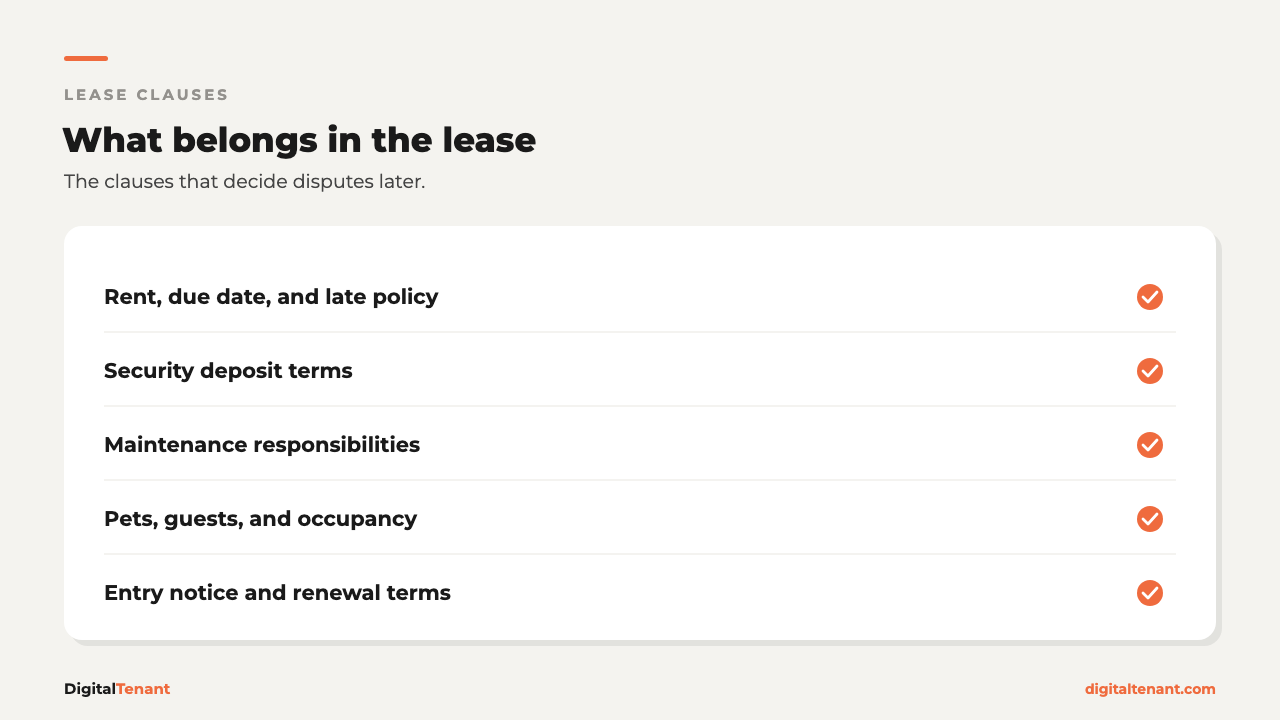
Here is the checklist I would hand any landlord or property manager writing a lease. Not every clause applies to every unit, and your state may require specific language on some of these. Treat it as the starting frame.
1. Parties and Property
Name every adult who will live there and sign, plus your legal landlord entity, like Sample Property LLC. Identify the exact unit, 123 Main St including any unit number. Vague parties mean vague responsibility.
2. Lease Term
Start date and end date. State whether it is a fixed term or month to month, and what happens at the end. Does it renew, convert to month to month, or require a new lease. Spell out the notice each side owes to end or not renew.
3. Rent Amount and Due Date
The monthly rent, the exact day it is due, and where and how it gets paid. If you take online payments, say so. Ambiguity here is the number one source of friction, so be blunt about it.
4. Late Fees and Grace Period
When rent is officially late, any grace period, and the late fee amount or formula. Many states cap late fees or require a minimum grace period, so confirm your local rule before you set the number.
5. Security Deposit Terms
The deposit amount, what it covers, and the conditions for getting it back. Note the timeline for returning it after move-out and how deductions get itemized. Deposit rules are among the most heavily regulated pieces of any lease, and they vary a lot by state, so this is one to get right.
6. Maintenance and Repair Responsibilities
Who handles what. What the tenant is responsible for, like changing filters or reporting issues promptly, and what you handle as the landlord. Include how a tenant submits a repair request and how you respond.
💡 Pro Tip: Give tenants one clear channel to submit maintenance requests and log every one. A tracked request beats a text you cannot find later, and it protects both sides if a repair ever becomes a dispute.
7. Entry Notice
Your right to enter for repairs, inspections, or showings, and the notice you will give first. Most states set a minimum notice period, commonly around 24 hours, so match the clause to your local law.
8. Occupancy and Guests
Who is allowed to live there and how long a guest can stay before they count as an occupant. This is how you keep a two-person lease from quietly becoming a five-person household.
9. Pets
Whether pets are allowed, any limits on type or size, pet deposit or pet rent, and the tenant's responsibility for damage. If you say no pets, say what happens if one shows up. Keep in mind assistance animals are treated differently under fair housing rules.
10. Utilities
Which utilities the tenant pays, which you cover, and how anything shared gets split. Leaving this open is a fast way to end up arguing over a water bill.
11. Rules and Policies
Quiet hours, parking, smoking, subletting, and anything specific to the property. Attach an HOA rule set or building policy if one applies. Reference it in the lease so it is part of the agreement, not a loose handout.
12. Signatures
Every adult tenant and the landlord sign and date. An unsigned lease is a draft, not an agreement. Digital signatures make this clean and keep a timestamped record, which matters if the term ever gets questioned.
How DigitalTenant Keeps Leases and Docs Organized Per Unit
Knowing what to include is half the job. The other half is keeping the signed lease, and everything attached to it, somewhere you can actually find it two years later.
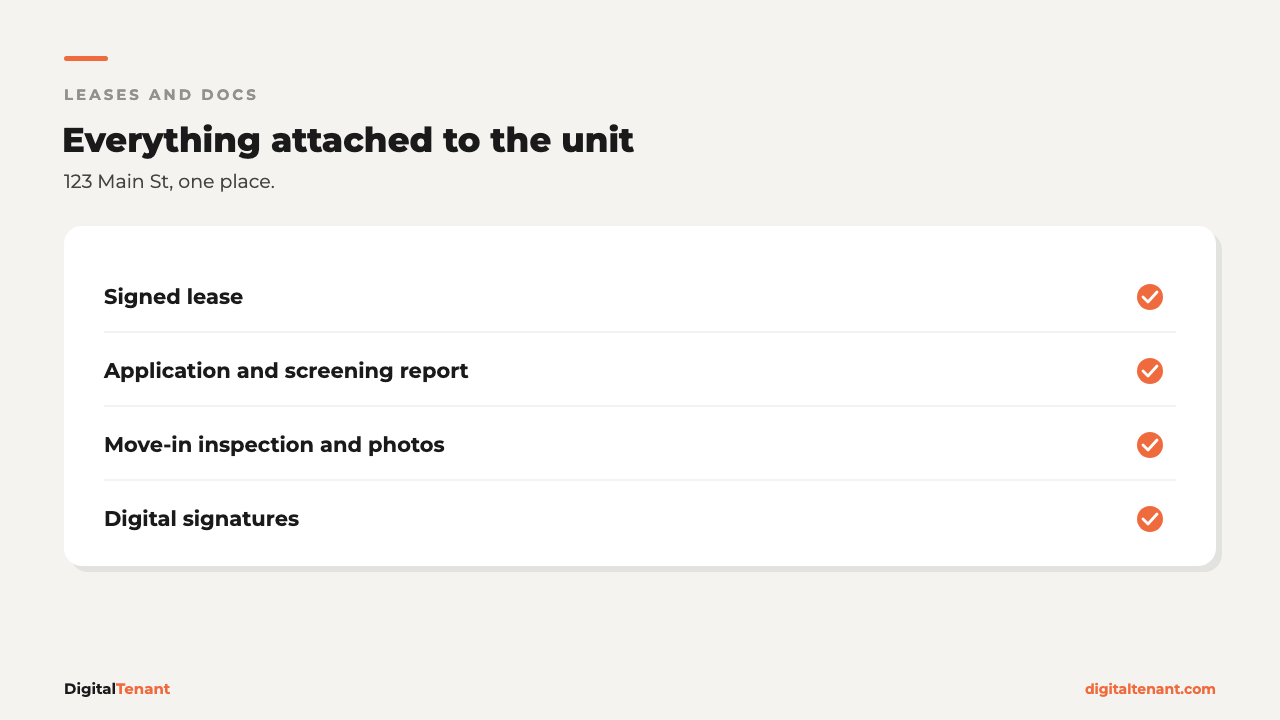
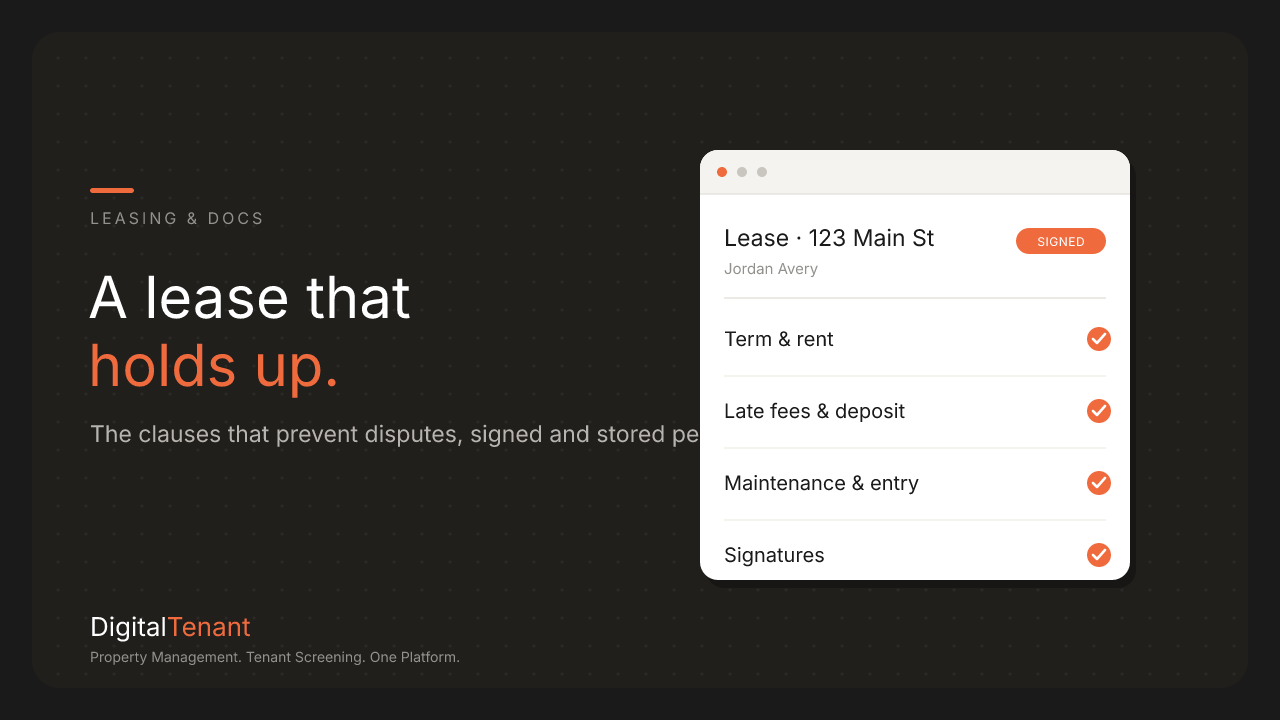
Inside DigitalTenant, Leasing and Docs lives with the unit. Applications, leases, and documents attach per unit, so the signed lease for 123 Main St sits right next to that tenant's application, screening, and rent payments. When a question comes up, you are not digging through email or a filing cabinet. It is all in one place, under the property it belongs to.
Digital signatures are built in, so the lease gets signed and stored without printing, scanning, or chasing paper. Per-lease signature pricing varies by tier. Lease creation is included starting on Property Standard at $59 a month, and every plan from Property Lite up carries digital signatures. The full tier breakdown is on our pricing guide.
The reason this matters is that the lease does not live alone. It connects to the screening you ran before move-in and the rent you collect after. Because landlords and property managers pay no fee to receive or view a Tenant Passport, the same platform that holds the lease also holds the applicant's own verified screening. You can see how that works on our landlord screening page, and tenants create their Passport on the tenant screening page. Screening, lease, and rent, all living with the unit.
⚠️ Common Mistake: Treating the lease as a one-time document you file and forget. The lease is the reference you reach for every time something goes sideways, so keep it attached to the unit where you can grab it fast.
Key Takeaways
- Knowing what to include in a rental lease agreement prevents most disputes, because a specific lease answers the question before it gets asked.
- A vague or generic lease shifts every gray area in the tenant's favor and costs you when something goes wrong.
- Cover the essentials: parties and property, term, rent and due date, late fees, deposit terms, maintenance, entry notice, occupancy, pets, utilities, rules, and signatures.
- Laws vary by state and this is not legal advice, so confirm local rules on deposits, late fees, and entry notice.
- DigitalTenant keeps leases, documents, and digital signatures attached per unit, right next to screening and rent.
Next Steps
- Pull your current lease and check it against the 12 clauses above.
- Fix the vague spots, especially rent due date, late fees, deposit terms, and entry notice.
- Confirm your state's rules on deposits, late fees, and notice, or ask a local attorney.
- Review the pricing guide to see where lease creation and digital signatures fit your unit count.
- Try DigitalTenant Free and create a lease that lives with the unit, next to screening and rent.
About the Author
Pierre Elize, Founder of DigitalTenant. Property Management. Tenant Screening. One Platform.
Your state's official lease rules and our free lease template, sent to your inbox.
Guides for landlords on screening, leases, rent and maintenance.