Introduction
Tenant screening for property managers is a different job than screening for a single unit. When you run one rental, you can read every application yourself, remember every applicant, and trust your own gut. When you run a portfolio across dozens of owners, none of that scales. You have team members pulling reports, owners with different expectations, and hundreds of applications a year moving through your pipeline. After years as a landlord and a licensed Colorado agent, I have watched managers get burned not by bad tenants, but by an inconsistent process. Here is how to run screening at scale and keep it fair, fast, and cheap.
Why Screening at Scale Is a Different Job
Screening one applicant is a decision. Screening at portfolio scale is a system. The difference is everything.
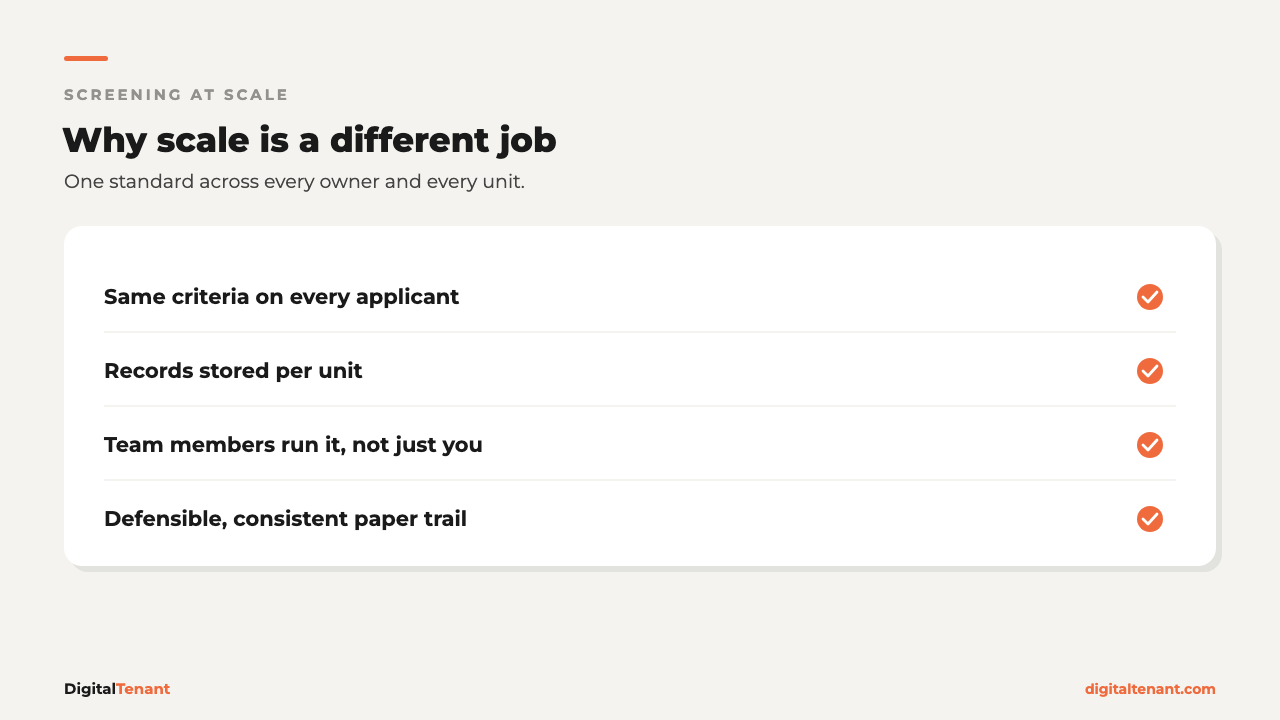
When you manage properties for other people, you are not just deciding who lives in a unit. You are defending that decision to an owner, to your team, and if it ever comes to it, to a fair-housing complaint. A landlord with three units can carry the criteria in their head. A manager with hundreds of units across many owners cannot, and neither can the three, five, or fifteen people running screening alongside them.
That is where the real risk lives. Not in one bad call, but in fifty slightly different calls made by different people on different days. Volume magnifies whatever process you have. If it is loose, scale makes it dangerous. If it is tight, scale makes it a strength.
The Framework for Tenant Screening for Property Managers
Good tenant screening for property managers comes down to a repeatable framework. Here is the one I would hand any manager building a screening operation.
1. Define Consistent, Objective Criteria
Write down what a qualified applicant looks like before you read a single application. Income multiple, credit threshold, eviction history, background standards. Put it on paper. Objective criteria applied the same way to every applicant is the foundation of everything else, including compliance.
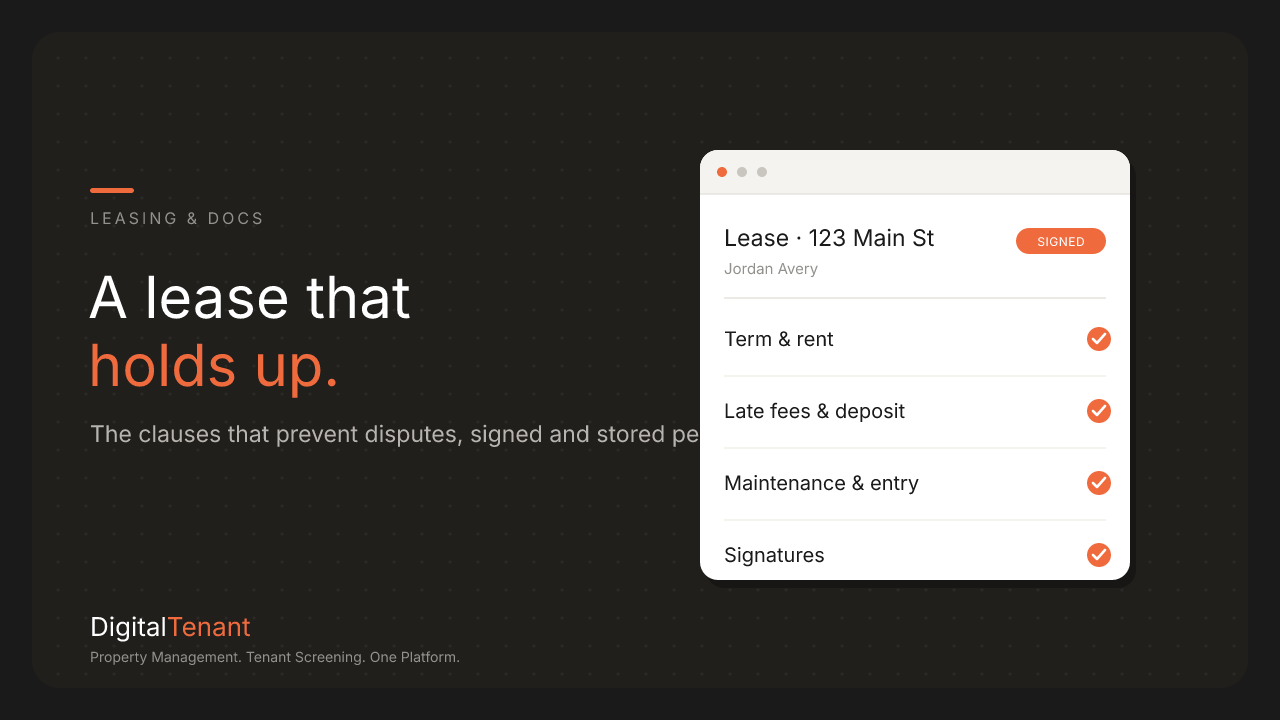
For Jordan Avery applying at 123 Main St, the answer should never depend on who happened to review the file that afternoon. The standard is the standard.
2. Stay Fair-Housing Compliant
Fair housing is not a checkbox. It is the reason the objective criteria above exist. Federal law protects applicants from discrimination based on protected classes, and inconsistent screening is how well-meaning managers land in trouble.
The protection is simple in principle. Apply the same objective criteria to every applicant, document how each decision was made, and never make exceptions that you cannot defend for everyone. When your whole team screens against one written standard, you are not just being fair. You can prove you were fair.
3. Verify Income and Identity, Not Just Credit
A credit score alone does not tell you whether someone can pay rent or whether they are who they say they are. At scale, faked income documents are a real problem. In a 2024 NMHC survey of apartment firms, 84 percent said they had seen applicants falsify pay stubs, employment references, or other income documents.
You need three things on every applicant: credit and background history, verified identity, and verified income. Pulling those from reliable sources, the same way every time, is what keeps a bad file from slipping through a busy week.
4. Standardize Across Your Team
This is the one most managers miss. Your screening is only as consistent as your least experienced team member. If screening lives in one person's inbox or one person's judgment, you do not have a system. You have a single point of failure.
Every person who touches an application needs the same criteria, the same reports, and the same view of the file. Team access to a shared screening workflow is what turns a written standard into an actual practice.
5. Control Per-Application Cost
Here is the one that hits the P&L. When you screen hundreds of applicants a year, screening cost is a real line item. Traditional models charge a fee on every single report, and at volume that adds up fast, whether you eat it or pass it to applicants.
The smartest move at scale is to stop paying to receive screening at all. More on exactly how that works below.
How DigitalTenant Handles PM-Scale Screening
I built DigitalTenant because I was tired of the tools that make screening harder as you grow. Here is how the platform maps to the framework above.
Standardized TransUnion and Plaid Screening
Screening runs on TransUnion for credit, background, and eviction reports, plus pay stubs checked for tampering through Plaid. Every applicant, every time, from the same sources. That consistency is exactly what fair-housing compliance and clean owner relationships require. The full landlord and PM side is on our landlord screening page.
The Tenant Passport Costs You $0 to Receive
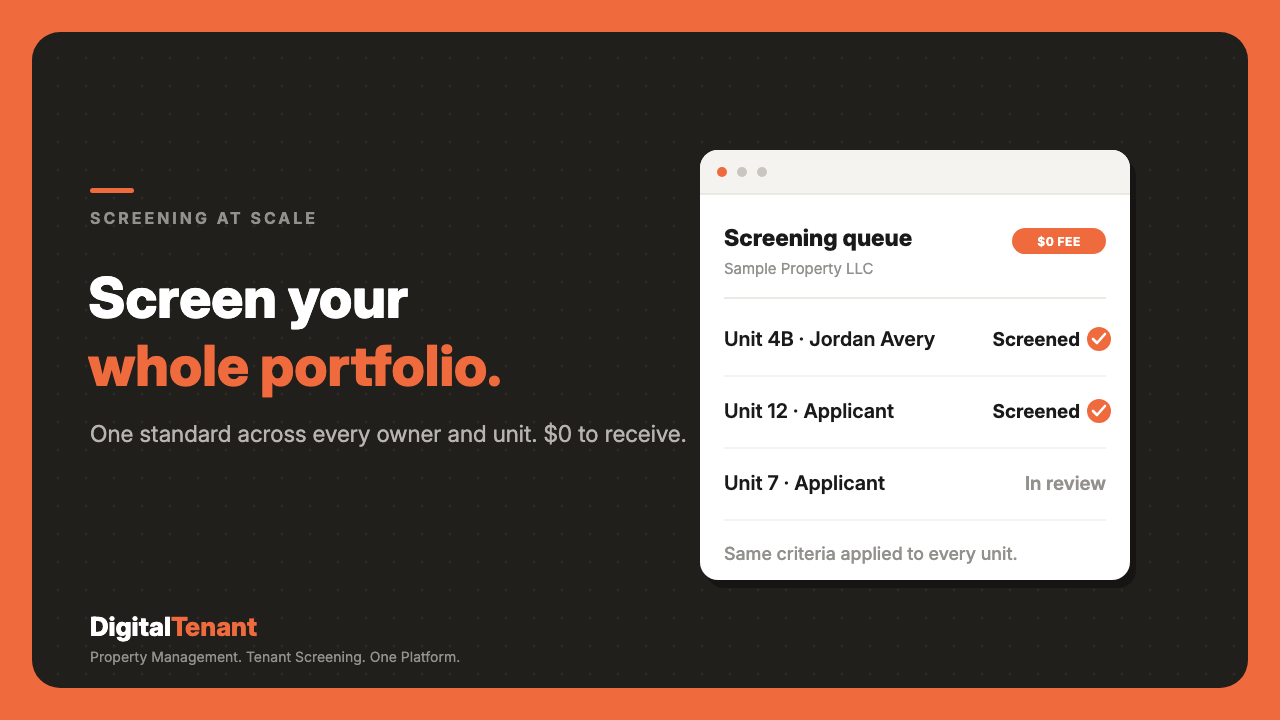
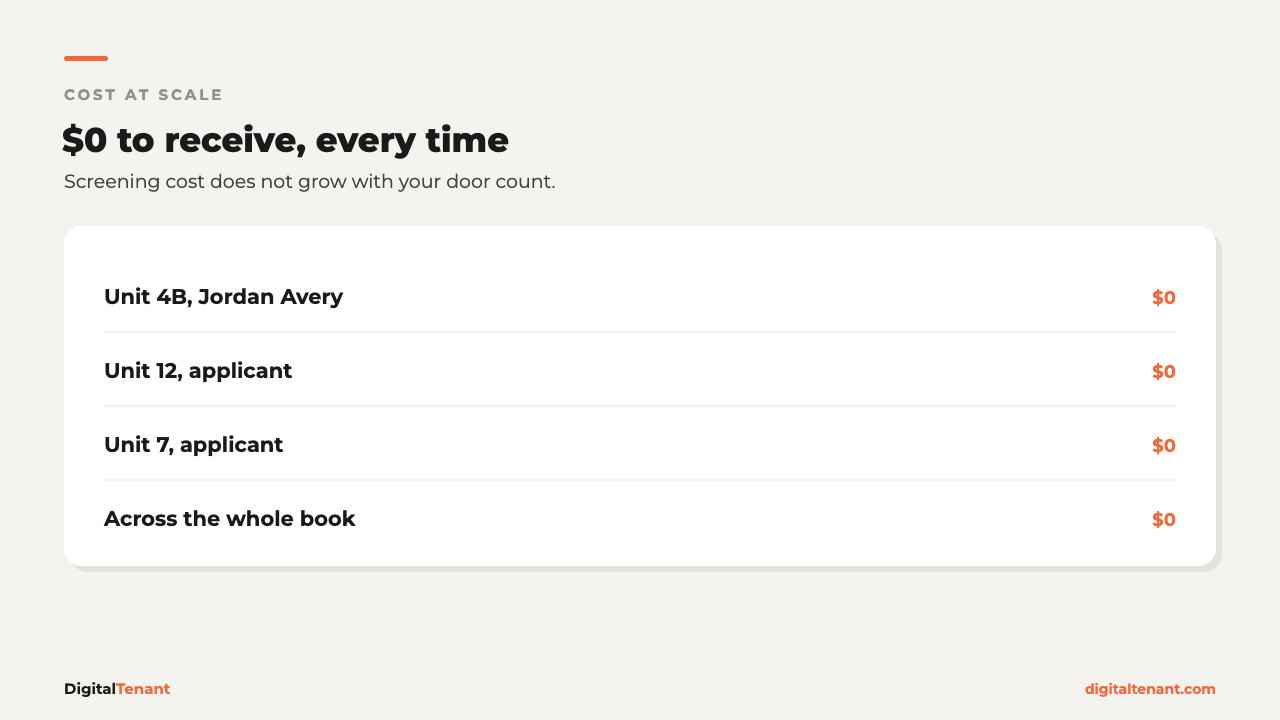
This is the big one at volume. When an applicant brings a Tenant Passport, you pay nothing to receive or view it. The tenant pays for their own screening. Multiply zero across hundreds of applications a year and compare it to a per-report fee model. The difference is real money back in the operation. The Passport goes beyond standard portable screening too, adding employment verification, rental history, and supporting income documents on top of credit, background, and eviction. Tenants can see how it works on our Tenant Passport page.
💡 Pro Tip: Encourage applicants to arrive with a Tenant Passport in hand. They skip repeat application fees, you skip the screening cost and the wait, and everyone moves faster.
Team Access So Everyone Screens the Same Way
Screening is not a solo activity at scale, so the platform is built for teams. Standard includes 3 team members, Pro includes 15, and Max includes unlimited team members and custom roles. Everyone works the same standardized workflow against the same criteria, which is how you keep fifty decisions from becoming fifty different standards.
Built-In Reporting on Top
The same system that screens your applicants also gives you 20 built-in reports across financial, leasing, operations, portfolio, and compliance, exportable to PDF, Excel, and CSV. One login, no second tool for the basics.
The Right Tier for a Property Manager
The platform tiers run from a free entry point up to portfolio scale:
- Property Lite, Free, up to 3 doors. Where a new landlord starts, and it still includes Tenant Passport access.
- Property Standard, $59 a month base, up to 255 doors. Independent landlords, 3 team members.
- Property Pro, $79 a month base, up to 1,500 doors. Mid-sized portfolios, 15 team members, white-label branding.
- Property Max, $99 a month base, 3,500-plus doors. Large portfolios and property managers, unlimited team members, priority phone support, and a dedicated account rep, with enterprise pricing available.
For a property manager screening at real volume, Property Max is the home base. The full breakdown is on our pricing guide.
⚠️ Common Mistake: Treating screening cost as fixed. At portfolio volume, a $0-to-receive Passport model changes the math on every application you process.
DigitalTenant is available nationwide, and the Tenant Passport is purpose-built for portable-screening laws like Colorado HB23-1099, which requires most landlords to accept portable screening reports.
Key Takeaways
- Tenant screening for property managers is a system, not a decision. Volume magnifies whatever process you have.
- Build on five things: consistent objective criteria, fair-housing compliance, verified income and identity, a standardized team workflow, and controlled per-application cost.
- DigitalTenant runs standardized TransUnion and Plaid screening, so every applicant is checked the same way.
- You pay $0 to receive a Tenant Passport. At hundreds of applications a year, that is real money back in the operation.
- Property Max is the PM home base, with unlimited team members, priority support, and enterprise pricing for large portfolios.
Next Steps
- Write down your objective screening criteria and confirm every team member screens against them.
- Audit your current per-application screening cost across a year at your real volume.
- Encourage applicants to bring a Tenant Passport so screening costs you nothing to receive.
- Map your unit count and team size to the right tier on the pricing guide.
- Try DigitalTenant Free and run a sample screening workflow end to end.
About the Author
Pierre Elize, Founder of DigitalTenant. Property Management. Tenant Screening. One Platform.