Introduction
If you rent out property, one question comes up before a tenant ever moves in: how much can a landlord charge for a security deposit? The honest answer is that it depends on where the unit sits. There is no single national number, and getting this wrong is one of the fastest ways to land in a dispute. I have been a landlord for years and I am a licensed agent, and I can tell you the deposit is where a lot of landlord-tenant fights start. Not the rent. The deposit. Set it right, document it right, and return it right, and you avoid most of the trouble.
Why Security Deposits Cause So Many Disputes
The deposit is the one pile of money that changes hands twice. The tenant gives it to you at move-in, and they expect most or all of it back at move-out. Between those two moments, a lot can go wrong.
Here is the usual story. A tenant moves out, you keep part of the deposit for damage, and the tenant says the wall was already scuffed when they arrived. Now it is your word against theirs. If you never documented the condition at move-in, you are guessing, and guessing is how you end up in small claims court.
The other common trigger is the return itself. Many states set a hard deadline to return the deposit, and some tack on penalties if you miss it. A landlord who returns the money late, or without explaining the deductions, can owe more than the deposit was worth. The deposit feels like a safety net. Handled loosely, it becomes a liability.
How Much Can a Landlord Charge for a Security Deposit by State
So back to the core question. How much can a landlord charge for a security deposit? The limit is set by state law, and it varies a lot.
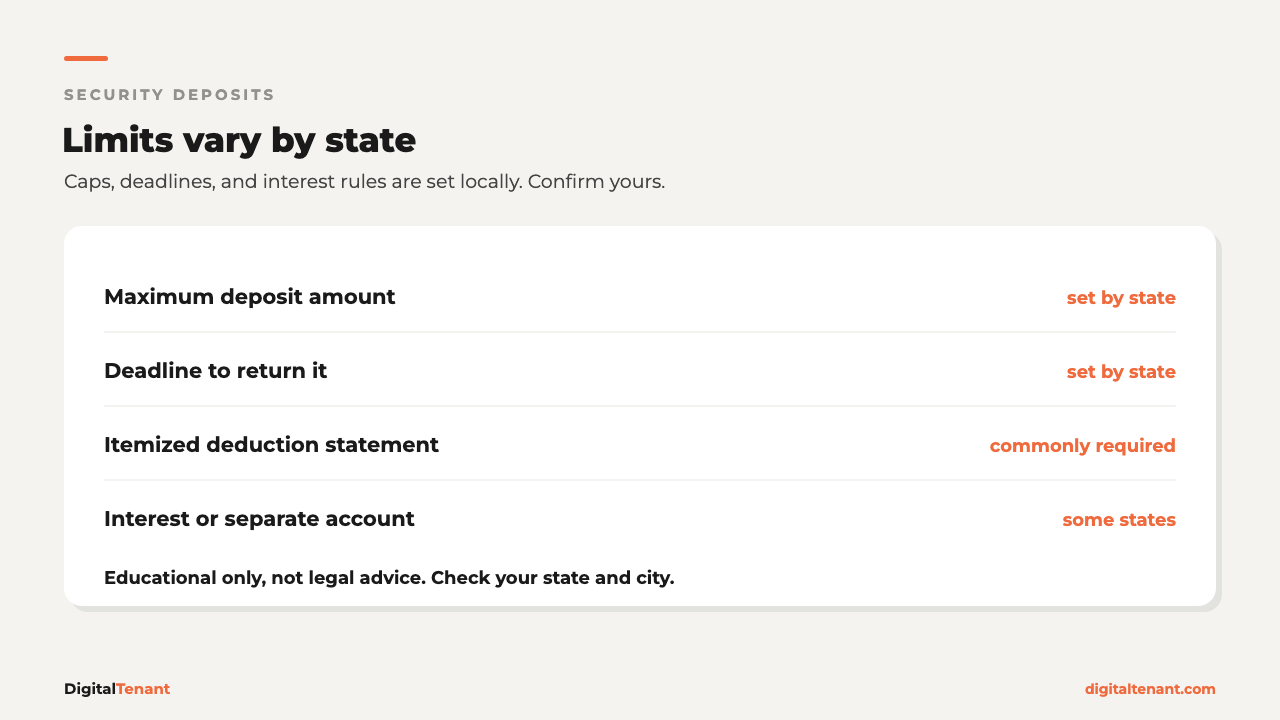
In many states the cap lands somewhere around one to two months of rent. Some states set a firm ceiling. Others set no statutory limit at all and leave it to the market. A few states have moved to tighten limits in recent years as part of broader tenant-protection efforts. That means the right number for a unit in one state can be flatly illegal in another.
A quick word here, because it matters. This article is general education, not legal advice. Deposit limits, allowable deductions, and return timelines all vary by state and sometimes by city. Before you set a number, check your own state and local rules, or ask a local attorney. Do not copy a figure from a landlord in another state and assume it applies to you.
What the Deposit Is Actually For
It helps to remember what a deposit is meant to cover in the first place. A security deposit protects you against costs a tenant leaves behind:
- Damage beyond normal wear and tear.
- Unpaid rent or fees.
- Cleaning to return the unit to move-in condition.
What it is not for is normal aging of the unit. Faded paint after several years, lightly worn carpet, small nail holes from hanging pictures. Those are usually considered ordinary wear and tear, and most states will not let you deduct for them. Knowing that line before you write the deposit terms into the lease keeps you honest and keeps you out of court.
A Simple Framework for Getting the Deposit Right
You do not need a law degree to handle deposits well. You need a repeatable process. Here is the one I use across my own units.
1. Know Your State's Limit and Rules
Start with the law where the property sits. Find three things: the maximum deposit you can charge, the deadline to return it, and whether your state requires the deposit to be held a specific way, such as in a separate account. Write those three facts down for each state you operate in. If you manage across state lines, you cannot run one policy everywhere.
2. Collect and Document the Terms
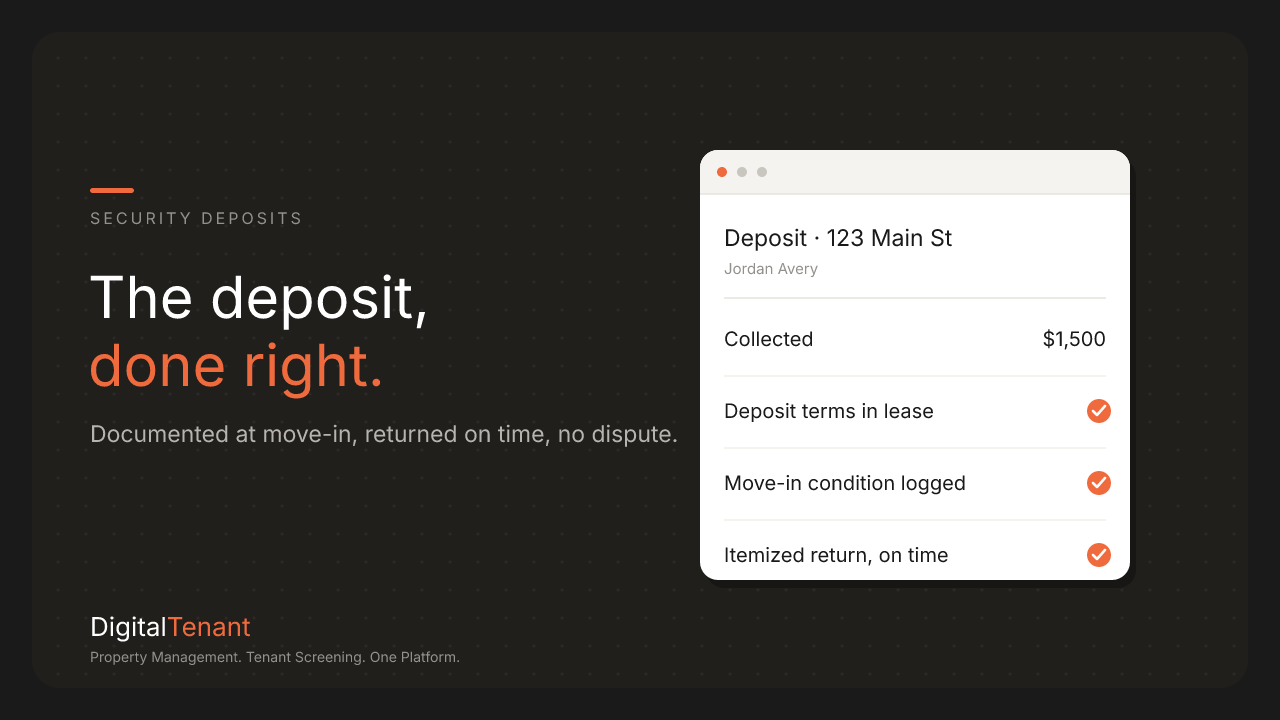
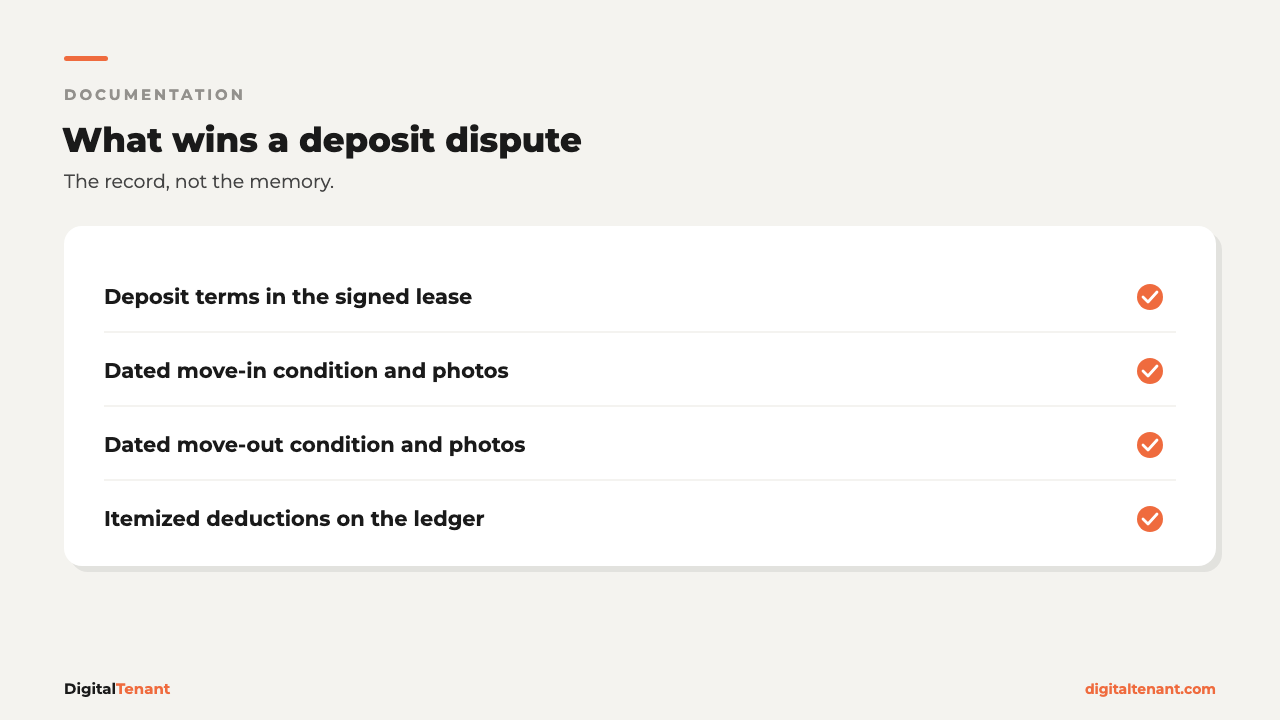
Put the deposit amount, what it covers, and the return terms directly in the lease. Do not leave it to a handshake or a text message. When Jordan Avery signs a lease for the unit at 123 Main St under Sample Property LLC, the deposit terms should be right there in the signed document, with the amount and the conditions spelled out. A clear written term is your first line of defense if anyone questions it later.
Solid screening before move-in also lowers the odds you ever need to lean on the deposit. A tenant with a clean rental and payment history is less likely to leave you with damage or unpaid rent. You can read how we handle that on our tenant screening side.
3. Document Condition at Move-In
This is the step most landlords skip, and it is the one that saves you. Before the tenant takes the keys, walk the unit and record its condition. Photos, dated notes, a signed move-in checklist. Capture the scuffed baseboard, the small stain, the appliance that already had a dent. Have the tenant sign off on it.
At move-out, you compare against that record. Now the question of what was damage versus what was already there is not a debate. It is documented. Keep those move-in records attached to the same file as the lease so everything for that unit lives in one place.
4. Deduct Only What You Can Actually Support
When it is time to settle up, only deduct for things the deposit is meant to cover, and only what you can prove. Unpaid rent, damage beyond normal wear and tear, and agreed cleaning costs. Keep the receipts and the before-and-after photos. If you cannot back a deduction with a document, do not take it. An unsupported deduction is exactly what turns a routine move-out into a claim.
5. Return It on Time With an Itemized Statement
When the tenant moves out, the clock starts. Return the deposit, or the balance after deductions, within your state's deadline. Include an itemized statement that lists every deduction, what it was for, and the amount. Attach copies of receipts where you can.
💡 Pro Tip: Send the itemized statement even when you are returning the full deposit and deducting nothing. A clean, documented return closes the loop and gives the tenant a reference for their next application. It costs you nothing and prevents the "where is my deposit" call.
How DigitalTenant Keeps the Deposit Organized
Most deposit disputes are really record-keeping failures. The money was fine. The paper trail was not. That is the part a good system fixes.
With DigitalTenant, the deposit lives inside the same place as everything else for the unit:
- Leasing & Docs. The signed lease and the deposit terms attach per unit, with digital signatures. Move-in photos and the condition checklist can live in the same file, so the terms and the proof are never in two different places.
- Rent collection and invoicing. Rent and deposit charges go out as invoices, and every payment shows up against its invoice, so the deposit, the rent, and any fees for Jordan Avery at 123 Main St are easy to review in one place. When you settle up at move-out, you are not rebuilding the history from a spreadsheet.
- Screening built in. TransUnion credit, background, and eviction reports, with pay stubs checked for tampering through Plaid, help you place a tenant less likely to leave you reaching for the deposit in the first place. And on the landlord side you pay no fee to receive a Tenant Passport. The tenant pays for their own screening. The details are on our landlord screening page.
You can run all of this on Property Lite, free for up to three units, and DigitalTenant works nationwide, so the same clean process follows you across state lines even though the deposit rules do not.
⚠️ Common Mistake: Keeping the lease in one folder, the move-in photos on your phone, and the deposit math in a spreadsheet. When a tenant disputes a deduction months later, the scattered version is the one that loses. Keep it all attached to the unit.
Key Takeaways
- How much can a landlord charge for a security deposit depends on state law. There is no single national figure, and limits often land near one to two months of rent, with some states capping it and others setting no limit.
- Limits, allowable deductions, and return timelines all vary by state and sometimes city. This is general guidance, not legal advice. Check your local rules.
- The deposit only covers damage beyond normal wear and tear, unpaid rent, and cleaning, not normal aging of the unit.
- Document condition at move-in, deduct only what you can support, and return the deposit on time with an itemized statement.
- Most disputes are record-keeping failures. Keeping the lease, move-in proof, and deposit records in one place for each unit prevents them.
Next Steps
- Look up your state's deposit limit, return deadline, and holding rules for each place you own property.
- Write the deposit amount and terms directly into every lease.
- Build a move-in condition record with dated photos and a signed checklist, and attach it to the unit file.
- Set a reminder to return deposits on time with an itemized statement, even when you deduct nothing.
- Review the pricing guide to see where your unit count fits, then Try DigitalTenant Free and keep every lease, deposit term, and payment in one place.
About the Author
Pierre Elize, Founder of DigitalTenant. Property Management. Tenant Screening. One Platform.
Your state's official lease rules and our free lease template, sent to your inbox.
Guides for landlords on screening, leases, rent and maintenance.