Introduction
You have got a unit sitting empty and a good applicant ready to go. Then they tell you they already have a screening report and ask you to use theirs instead of paying for a new one. If you own or manage rentals in Colorado, that is not a favor you are doing them. It is the law. Knowing how to accept portable screening reports in Colorado the right way keeps you compliant with HB23-1099 and, honestly, gets a qualified applicant across the finish line faster. After years running my own rentals as a landlord and a licensed Colorado agent, I would rather have a clean report in hand today than wait three days for a new one to run.
This is educational, not legal advice, and screening laws vary by state, so check your local rules and the current statute. But here is how the process actually works when someone hands you a portable report.
What a Portable Screening Report Actually Is
A portable screening report is a tenant screening report that the applicant paid for once and can reuse across multiple landlords. Instead of paying a fresh application fee at every property, the tenant buys their report and shares it with you.
At a minimum it usually includes a credit report, a background check, and eviction history. That is the same core information you would pull yourself. The difference is who paid for it and who ordered it. With a portable report, the tenant did.
For you as the landlord, the report is the same underlying data you need to make a decision. You are just receiving it instead of ordering it. Done right, that saves the applicant a repeat fee and saves you the wait.
What Colorado HB23-1099 Requires of You
Colorado HB23-1099 took effect in August 2023 and changed the rules for landlords across the state. HB25-1236 updated it starting January 1, 2026. Here is the short version of what it means for you as the person accepting the report.
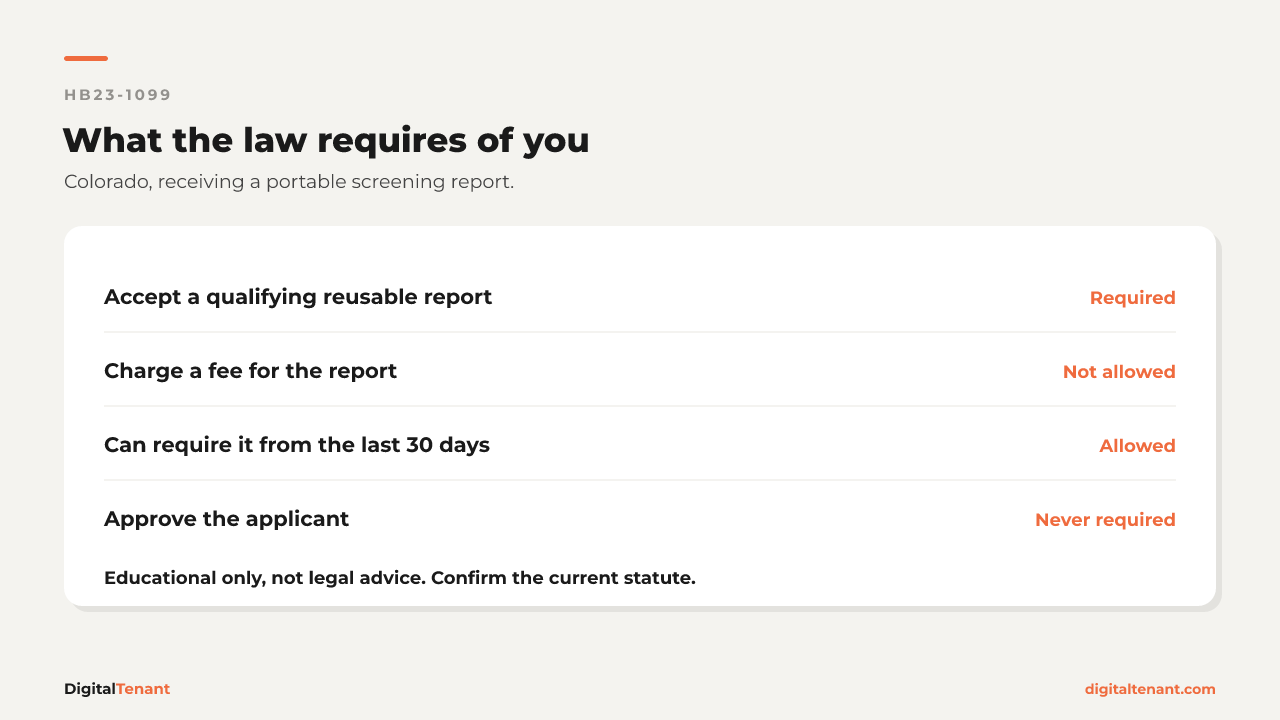
- You have to accept a reusable tenant screening report when an applicant offers one that meets the requirements. You cannot refuse it just because you would rather run your own. (The one exemption: you take only one application fee at a time for a unit and refund it in full within 20 calendar days after either side declines the lease in writing. Few landlords work that way.)
- You cannot charge that applicant a screening or application fee for the report if they provided a qualifying portable one. Charging for a screen the tenant already paid for is the exact thing the law is meant to stop.
- You can require a recent report. The statute lets you require that it was completed within the previous 30 days, so a report from many months back does not qualify. Check the applicant's report date against that window.
- You can still require the tenant to state the report is accurate and that there has not been a material change, like a new eviction filing, since it was pulled.
- You have to tell applicants up front. Before you take any screening step you would normally charge an application fee for, let them know they have the right to give you a portable report and that you cannot charge them an application fee or a fee to access or use it if they do. Your listing, your website's home page, or the application itself all work, generally in at least 12-point bold type.
- Since January 1, 2026, the applicant can send you the report themselves. HB25-1236 removed your option to require that the report come straight from the screening company or a third-party screening website. It also says an applicant renting with a housing subsidy does not need a credit history report, a credit score, or adverse credit events in their portable report.
The point of the law is simple. Renters were paying $40 to $60 in application fees at every single property, sometimes five or ten times for one apartment search. HB23-1099 says if the tenant already paid for a valid report, you use it. Again, confirm the exact fee limits and recency window in the current statute, because those details are the ones that get updated.
How to Verify a Portable Screening Report Is Legit
Accepting a report does not mean accepting whatever a tenant emails you at face value. You still get to confirm it is real, complete, and current. This is the operational part most landlords ask me about.
1. Confirm Where the Report Came From
A qualifying report is a consumer report with information from a consumer reporting agency, not a screenshot the applicant typed up. Since January 1, 2026, you can't require that it come to you straight from the provider, so an applicant may simply send it to you. Look for the provider's name and the date the information is current through. If you cannot tell who prepared it, ask questions before you rely on it, and check the current statute before you turn it down.
2. Check the Date
Colorado lets you require a report completed within the previous 30 days, so match the report date against that window. If it is inside the window, good. If it is stale, you can ask the applicant for a current one. A report from last spring on a unit you are filling this month may not qualify.
3. Make Sure It Covers What You Need
Confirm the report actually includes the pieces you screen on. Credit, background, and eviction history at a minimum. If the report is missing a category you rely on, you can ask for the applicant to provide it, within what the law allows. One exception since January 1, 2026: an applicant renting with a housing subsidy does not need credit history, a credit score, or adverse credit events in their report.
4. Verify the Applicant Matches the Report
The name on the report needs to be the person standing in front of you. Check the identity details on the report against the applicant's ID and application. A report for a different Jordan Avery does you no good.
5. Get the Applicant's Statement
Have the applicant confirm in writing that the report is accurate and nothing material has changed since it was pulled. That is a reasonable step the law allows, and it protects you if something like a recent eviction filing would not yet show up.
💡 Pro Tip: Build one short intake step for portable reports before you ever start a walk-through. Confirm the source, the date, the coverage, and the applicant's written statement in one pass. When you standardize it, accepting a portable report is faster than ordering a new screen, not slower.
Staying Compliant Without Slowing Down the Fill
The fear I hear from landlords is that accepting portable reports means losing control of screening and dragging out the process. It does not have to. A few habits keep you compliant and keep the unit moving.
- Apply the same standard to everyone. Whatever criteria you use, income, credit, history, apply it to both applicants who bring a portable report and applicants you screen yourself. Consistent criteria is how you stay on the right side of fair housing.
- Do not charge a fee for a report you did not run. If the tenant brought a qualifying portable report, you do not get to add a screening fee on top. Know the fee rules before you send your application.
- Document your decision. Keep the report, the applicant's statement, and your criteria together so you can show why you approved or declined. If it ever gets questioned, your file answers the question.
- Keep your window tight. The applicant who hands you a current report today can be approved today. Move on it. A portable report is supposed to speed you up.
How the Tenant Passport Fits, and Why You Pay No Fee
Here is where DigitalTenant makes this easy on your side. The Tenant Passport is a portable, verified screening report built for exactly this law. The tenant creates it, the tenant pays for it, and they share it with you.
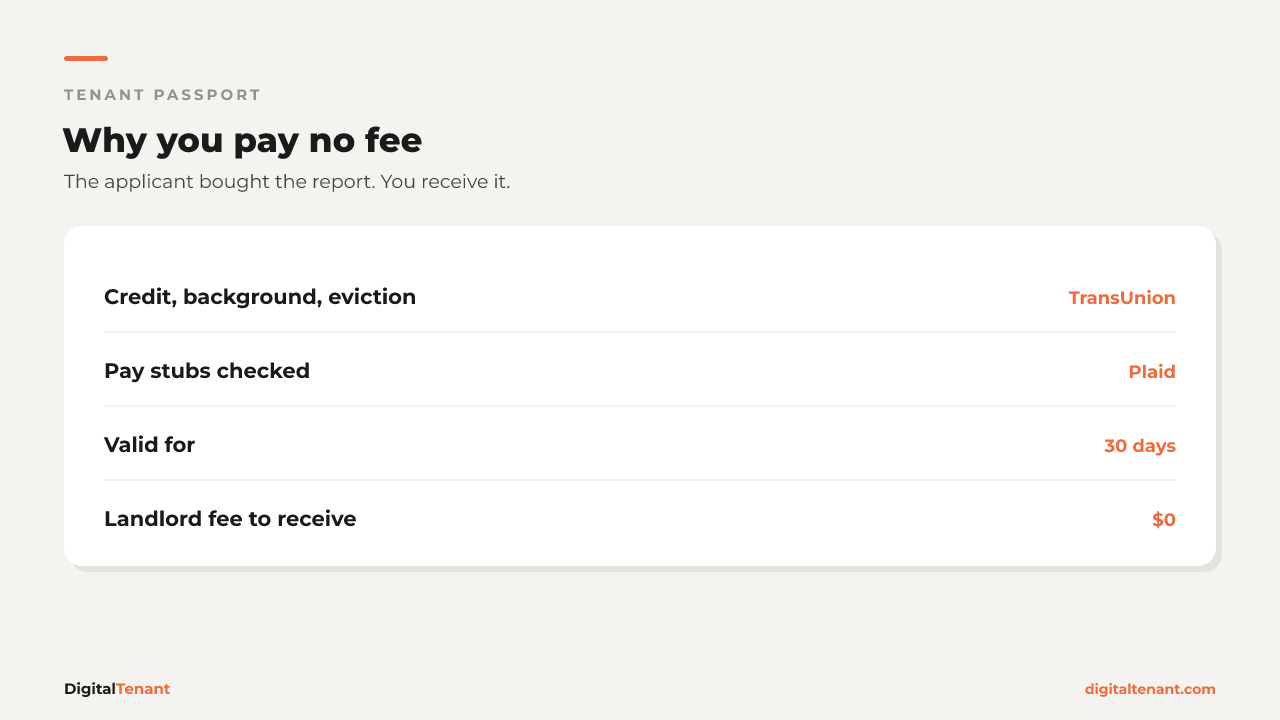
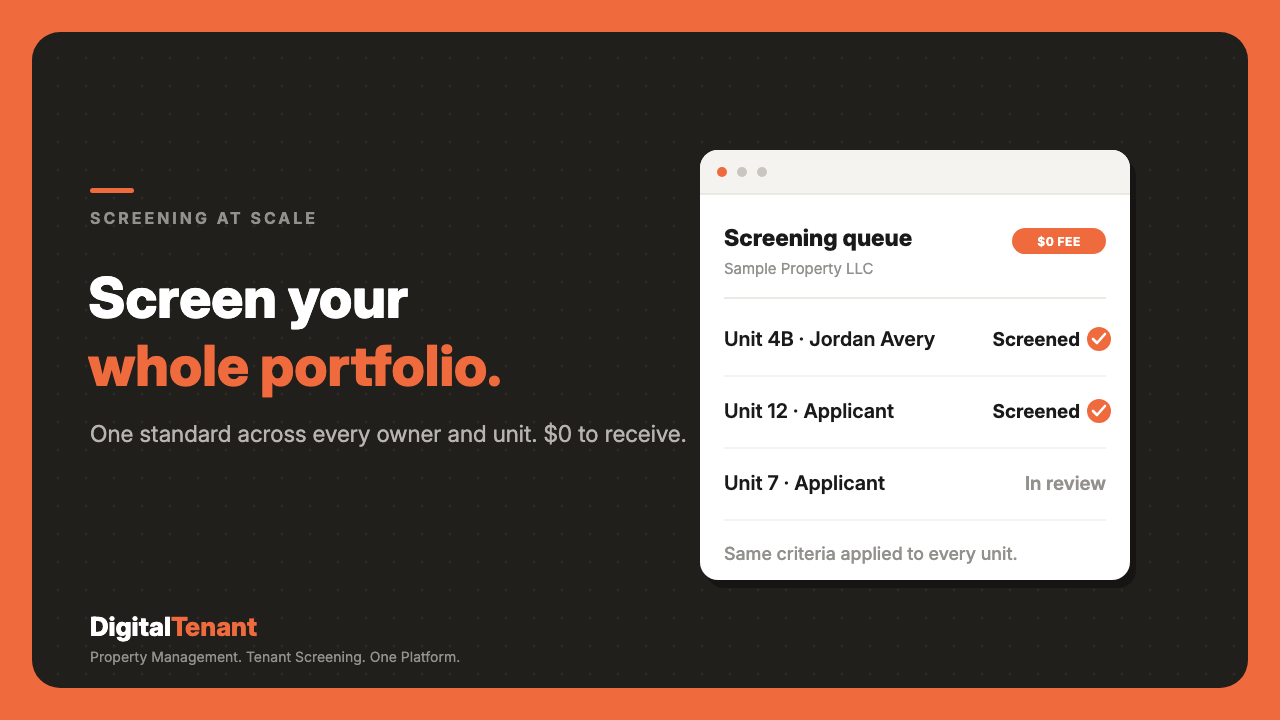
For you as the landlord or property manager, the part that matters most: you pay no fee to receive or view a Tenant Passport. The tenant covers their own screening. You just get the report. That is the whole idea behind the Passport, and it lines up with what HB23-1099 asks of you. Tenants shouldn't have to pay over and over to prove they're good renters. The Tenant Passport is proof.
It also goes beyond a standard portable report. A Tenant Passport includes credit, background, and eviction, plus employment verification, rental history, screening questions, and supporting income documentation. So instead of a bare-minimum report, you get a fuller picture of the applicant in one place, verified, without ordering anything yourself. The landlord side of the Passport is laid out on our landlord screening page.
And if you would rather run your own screen for an applicant who does not have a portable report, that lives in the same platform too, with TransUnion credit, background, and eviction built in. You can see how tenants create a Passport on our tenant screening page.
You can start on Property Lite, which is free for up to 3 units, and accept a Tenant Passport from your very first applicant. The full breakdown is on our pricing guide.
Key Takeaways
- Colorado HB23-1099 requires most landlords to accept a qualifying portable screening report and bars you from charging that applicant a screening fee for it.
- A portable report includes at least credit, background, and eviction history. It is the same data you need, just paid for and ordered by the tenant.
- Before you accept one, verify the source, check the date against the recency window, confirm it covers what you screen on, match the applicant to the report, and get their written statement.
- Apply the same criteria to everyone and document your decision so a portable report speeds up the fill instead of creating risk.
- The Tenant Passport is a portable report built for this law. You pay no fee to receive or view it, and it goes beyond a standard report with employment, rental history, and income documentation.
- Screening laws vary by state. This is educational, not legal advice, so confirm the current statute and fee limits.
Next Steps
- Read the current HB23-1099 requirements so you know the recency window and fee limits before your next applicant.
- Build a one-pass intake step to verify a portable report: source, date, coverage, identity match, and written statement.
- Apply the same screening criteria to portable-report applicants and self-screened applicants alike, and keep the file.
- Learn how a Tenant Passport works on the landlord screening page, where you pay no fee to receive or view one.
- Try DigitalTenant Free on Property Lite and accept your first portable report without adding a fee.
About the Author
Pierre Elize, Founder of DigitalTenant. Property Management. Tenant Screening. One Platform.
With Tenant Passport, applicants bring one screening report they can reuse, and screening costs landlords nothing.
Guides for landlords on screening, leases, rent and maintenance.