How to Screen a Tenant: A Step-by-Step Guide for Landlords
The tenant you approve is the single biggest decision you make on a rental. Rent collection, maintenance, whether you sleep at night, all of it traces back to that one call. So learning how to screen a tenant the right way is not paperwork. It is the whole ballgame. I have been a landlord for years and I am a licensed Colorado agent, and I have made this call the lazy way and the disciplined way. The disciplined way wins every time. Here is how I screen a tenant now, step by step, so you can fill your unit fast without gambling on a stranger.
Why Screening Is the Decision That Matters Most
A vacant unit costs you money every day it sits empty. That pressure is real, and it is exactly what pushes good landlords into bad decisions. You get a nice email from an applicant, they seem friendly at the showing, and suddenly you are ready to hand over the keys on a gut feeling.
Gut feeling is not a screening process. A wrong tenant can cost you months of unpaid rent, a damaged unit, and a Colorado eviction that eats your summer. The right tenant pays on time and disappears in the best way. The difference between those two outcomes is the work you do before anyone signs.
The goal is simple. Get a complete, qualified application. Verify it is real. Decide fast. Fill the unit.
The Bad Options Most Landlords Fall Into
Before the good way, let me name the traps. I have stepped in all of them.
- Guessing from gut. They seemed nice. That is not data. Nice people miss rent too.
- Accepting an incomplete application. Blank employer field, no prior landlord, no income proof. Now you are chasing paystubs by text for a week while the unit sits.
- Trusting screenshots. A tenant sends you a photo of a bank balance or a pay stub. Anyone can edit those. You need verified data, not a picture.
- Making good applicants pay again. A strong applicant already got screened last week down the street. If you make them pay another fifty-five dollars to apply with you, they ghost you and take the unit that did not charge them. You just lost your best applicant over a fee you did not even collect.
Every one of those slows you down or hands you a bad tenant. The fix is a process you run the same way every single time.
How to Screen a Tenant, Step by Step
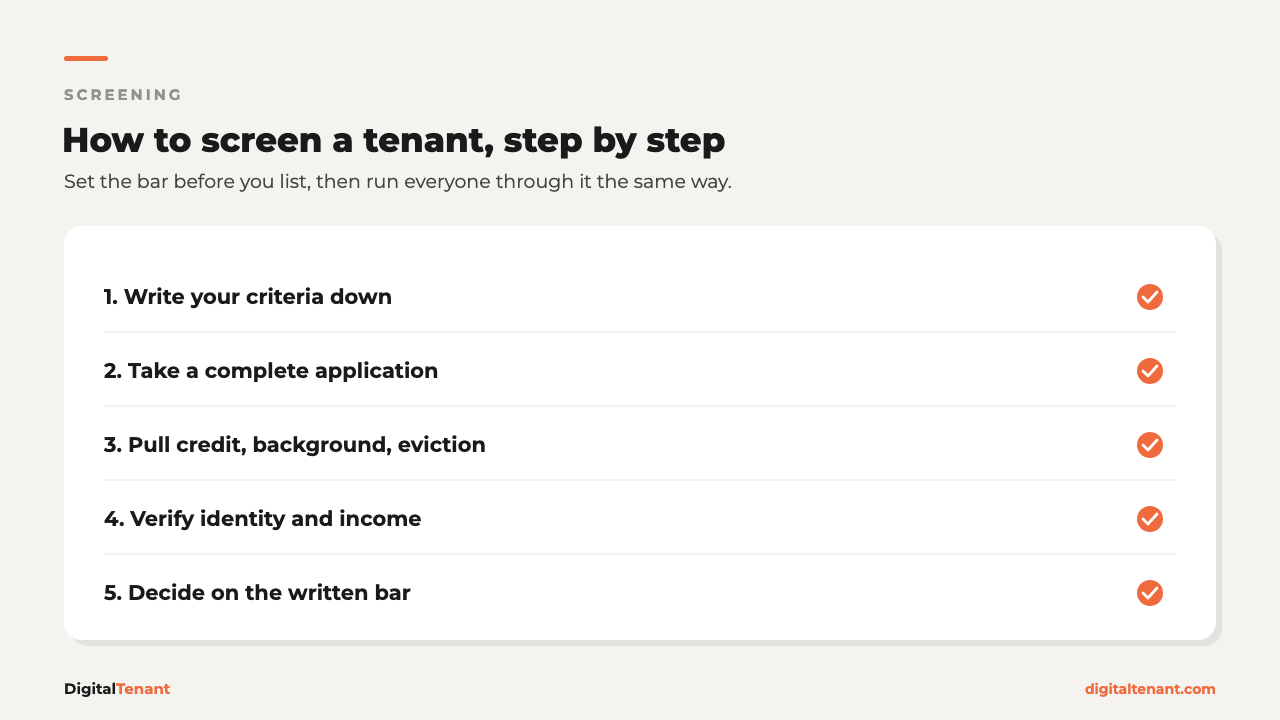
Here is the framework. Six steps, in order. Run all of them, on every applicant, no exceptions.
 1. Require a Complete Rental Application
Do not evaluate anyone until the application is finished. Full name, current and prior addresses, employment, income, and permission to run credit and background. If a field is blank, the application is not done, and you do not start the work. A complete application up front saves you the paystub chase later.
2. Verify Identity and Income
Confirm the applicant is who they say they are, and that they actually earn what they claim. The old rule of thumb is income of roughly three times the rent, but the number matters less than the verification. Screenshots and forwarded PDFs are not proof. Bank-connected, verified income is. This is where a lot of application fraud gets caught.
3. Pull Credit, Background, and Eviction
This is the core report. Credit tells you how they handle money. Background and eviction history tell you about past risk and prior removals. You want all three in one place, pulled from a real bureau, not a stranger's summary of themselves.
4. Check Rental History and References
Call the prior landlord. Not the current one who might be motivated to pass along a problem tenant, but the one before. Did they pay on time? Did they leave the place clean? Did they give proper notice? Rental history is often the most honest predictor you have.
5. Apply Consistent, Fair-Housing-Safe Criteria
Write down your criteria before you screen anyone. Minimum income, credit threshold, no prior eviction, and so on. Then apply those exact criteria to every applicant, in the same order, every time. That consistency is not just fair. It is your protection under fair housing law. You judge the application, never the person. Objective criteria applied evenly to everyone keeps you clean and keeps your decision defensible.
6. Decide Fast
Speed is part of screening. The best applicants have options and they move quickly. Once your criteria are met and verified, make the call and send the lease. A week of "let me think about it" is a week your top applicant spends signing somewhere else.
The Better Way: How DigitalTenant Screens for You
That six-step process is a lot of manual work when you do it with email, phone calls, and a stack of PDFs. This is exactly the frustration I built DigitalTenant to fix. Here is how the platform runs those same steps for you.
Screening Is Built In
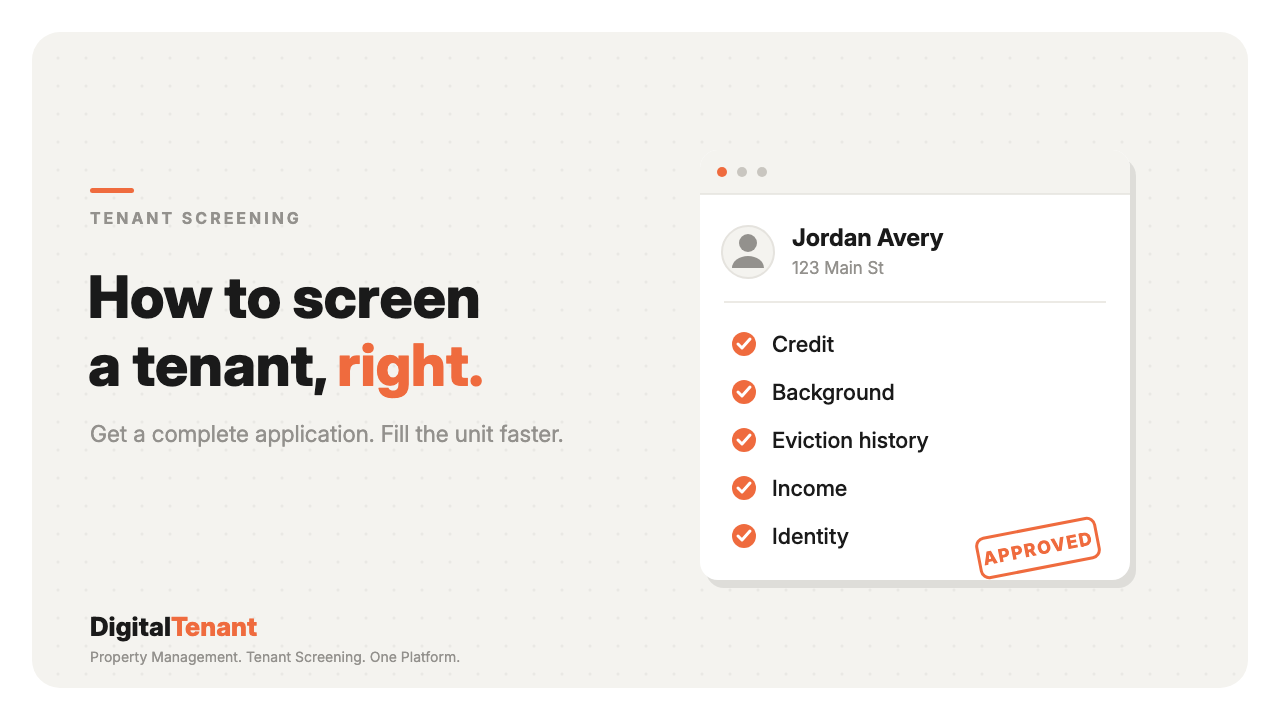
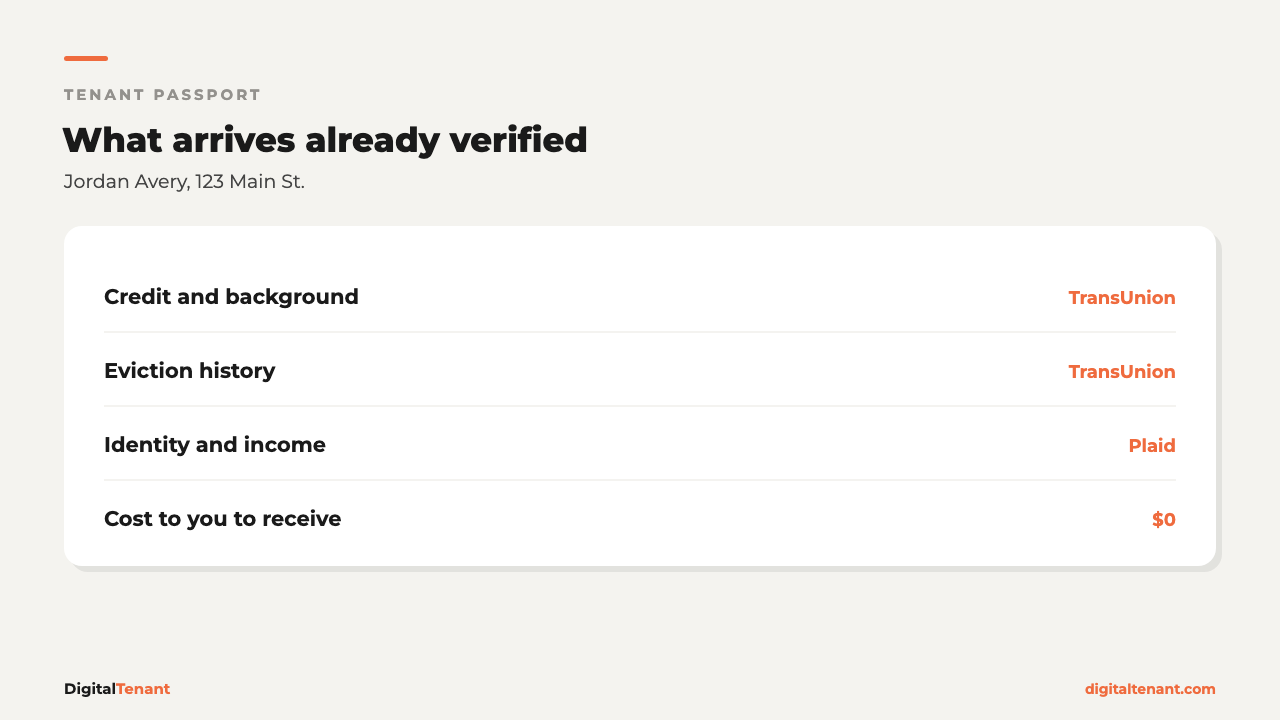
Credit, background, and eviction come from TransUnion, right inside the platform. Identity and income are verified through Plaid, connected to the applicant's actual bank, not a screenshot. So steps two and three above happen automatically, with real data you can trust. The rental application and screening live in one place, so nothing shows up half-finished.
You Pay No Fee, and Your Applicant Does Not Get Charged Twice
Here is the part that changes the math for you. As a landlord, you pay no fee to receive or view a Tenant Passport. The tenant pays for their own screening, once, and can reuse that verified profile across multiple landlords. So a strong applicant does not have to pay another fifty-five dollars just to apply with you. They do not ghost you over a repeat fee, and you fill the unit faster. The full landlord side of that is on our landlord screening page.
A Profile That Goes Beyond Standard Screening
The Tenant Passport is more than a credit pull. It adds employment verification, rental history, basic security and screening questions, and supporting income documentation, all attached to the applicant. That covers steps one through four of the framework in a single verified profile that lands on your desk complete. You can see how tenants build it on the Tenant Passport page.
Pro Tip: If you are in Colorado, HB23-1099 requires most landlords to accept portable screening reports. The one exemption is narrow: you take only one application fee at a time for a unit and refund it within 20 days when either side declines. Almost nobody runs a vacancy that way.
What This Costs You
You can start on Property Lite for free, which covers up to three units and includes Tenant Passport access. That means you can receive verified applicant profiles at no cost while you get comfortable with the platform. As you grow, Property Standard runs $59 a month, Property Pro is $79, and Property Max is $99. The full breakdown is on our pricing guide.
Key Takeaways
- Knowing how to screen a tenant is the most important skill a landlord has. The tenant you approve drives every outcome that follows.
- Skip the bad options. Gut feelings, incomplete applications, and edited screenshots cost you time and money.
- Run all six steps every time. Complete application, verified identity and income, credit and background and eviction, rental history, consistent fair-housing-safe criteria, and a fast decision.
- Consistent, objective criteria applied to every applicant is both fair and your legal protection.
- DigitalTenant builds screening in with TransUnion and Plaid, and you pay no fee to receive a verified Tenant Passport. Your best applicant does not get charged twice, so you fill the unit faster.
Next Steps
- Write down your screening criteria today, before your next applicant, so you apply them evenly to everyone.
- Stop accepting screenshots. Require verified income and identity on every application.
- Review the landlord screening page to see how a no-fee Tenant Passport reaches you.
- Check the pricing guide and pick the tier that fits your unit count.
- Try DigitalTenant Free and screen your next applicant end to end.
About the Author
Pierre Elize, Founder of DigitalTenant. Property Management. Tenant Screening. One Platform.
With Tenant Passport, applicants bring one screening report they can reuse, and screening costs landlords nothing.
Guides for landlords on screening, leases, rent and maintenance.