Introduction
Good renters are paying to prove the same thing over and over. That is the part of renting nobody designed on purpose, and it is the part that bugs me most.
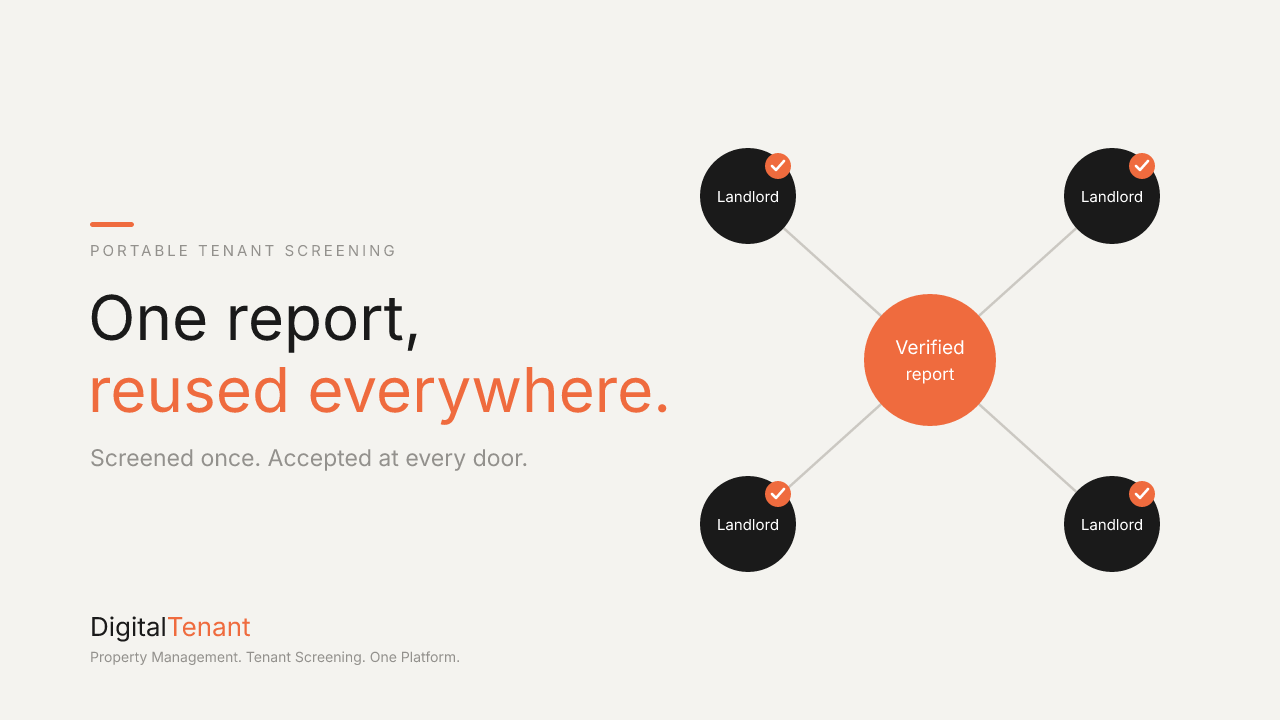
Portable tenant screening fixes it. Instead of buying a fresh background and credit check at every door, a renter gets screened one time, then reuses that same verified report everywhere they apply. One screening. Many applications. After managing my own rentals for years, and sitting on both sides of the application desk as a landlord, I can tell you the old way is slower and more expensive than it needs to be, for renters and landlords alike.
Let me walk you through what portable tenant screening actually is, why the current setup is broken, and how the Tenant Passport plus a Colorado law called HB23-1099 turns one screening into something you can use again and again.
What portable tenant screening is
Portable tenant screening means the screening report belongs to the renter, not to a single landlord's one-time application. The renter pays for a verified credit, background, and eviction check once. Then they carry that report with them and present it to any landlord who will accept it.
Compare that to how most applications still work. You apply at one place, you pay a fee, the landlord pulls a report, and that report dies the moment you do not get the unit. Apply somewhere else and you start from zero. New fee. New pull. Same data.
The word that matters is "portable." The verification travels with the person it describes, because that is who it is actually about.
DigitalTenant's Tenant Passport goes beyond the standard version of this. On top of credit, background, and eviction, it adds employment verification, rental history, basic security and screening questions, and supporting income documentation. That is more than most other portable screening products put in one place, which means a landlord reading a Passport gets a fuller picture, not a thinner one.
Why repeat application fees are broken for renters
Here is the math that made me uncomfortable as a landlord. A single rental application in a competitive market runs about $55. In a tight rental season, a good renter might apply to four or five places in a couple of weeks. That is $220 to $275 spent, and in most of those cases the renter walks away with nothing. The unit went to someone who applied an hour earlier.
Think about who eats that cost. It is not the bad applicant who never follows through. It is the careful renter, the one who pays on time and keeps the place clean, applying again and again because the good units go fast. We built a system that charges the most reliable people the most money, just to keep proving a fact that did not change between Tuesday and Friday.
⚠️ Common Mistake: Renters often assume the application fee buys them something they keep. It does not. In the old model the report belongs to that one landlord, for that one unit, and it is gone the second the decision is made.
And the credit pull underneath it all? It is the same TransUnion data every time. The renter pays full price for a fresh copy of an answer three other landlords already have.
Why the old screening process is slow for landlords
Now flip to my side of the desk, because portable tenant screening is not only a renter problem. It is a landlord problem too.
When I list a unit, I want a qualified tenant in it quickly. Every empty day is lost rent. But the traditional process puts friction right at the worst moment. The applicant has to start a brand new screening, authorize a new pull, and wait. Some good applicants stall out simply because they do not want to pay another $55 on a place they might not get. So they wait to see if they are a finalist, which slows me down, which means the unit sits.
I have watched strong applicants drop out of the funnel for no reason other than fee fatigue. A renter like Jordan Avery, clean history and steady income, hesitates to pay for a fifth report this month. That hesitation costs me a fast, clean lease-up.
Slow screening is not a small inconvenience. On a unit renting at market rate, a week of extra vacancy can cost more than a month of software.
What a verified screening report actually checks
Part of why people accept the repeat-fee model is that screening feels like a black box. It should not. A complete report is just a few clear checks, and once you see them laid out, you understand why one good verification can safely be reused.
Here is what goes into a full DigitalTenant screening:
- TransUnion-verified: credit history and score, so a landlord sees how the applicant handles money.
- TransUnion-verified: a background check, for the safety picture every owner is responsible for.
- TransUnion-verified: eviction history, the single most predictive signal of how a tenancy is likely to go.
- Plaid-verified: identity, confirming the applicant is who they say they are.
- Plaid-verified: income, connected straight to the source instead with the option of uploaded your pay stub via PDF.
None of those facts change because a renter walked to a different building. The credit file is the credit file. The eviction history is the eviction history. That is the whole logic of portable tenant screening. If the verification is solid and recent, reusing it is not a shortcut. It is just common sense.
💡 Pro Tip: Landlords, when you accept a portable report, check the issue date and confirm it covers credit, background, eviction, identity, and income. A recent report that covers all five is as good as one you ordered yourself, and you get it without making a good applicant pay again.
How the Tenant Passport makes one portable tenant screening reusable
This is the problem we built the Tenant Passport to solve. So here is how it works, step by step.
- The renter creates a Tenant Passport and completes one verified screening. Credit, background, and eviction through TransUnion. Identity and income through Plaid.
- The screening is tied to the renter, not to a single listing. It is theirs to keep and theirs to share.
- When they find a place they want, they present the Passport to the landlord instead of starting a new paid application.
- The landlord reviews a verified, standardized report right away. No waiting on a fresh pull. No black box.
- The renter applies to the next place with the same Passport. No second $55. No starting over.
For the renter, the repeat-fee treadmill stops. For the landlord, the slowest step in lease-up gets faster, because the qualified applicant already has proof in hand. This is the rare fix that is genuinely better for both sides at once. The renter saves money, the landlord saves vacancy days, and the verification quality does not drop at all.
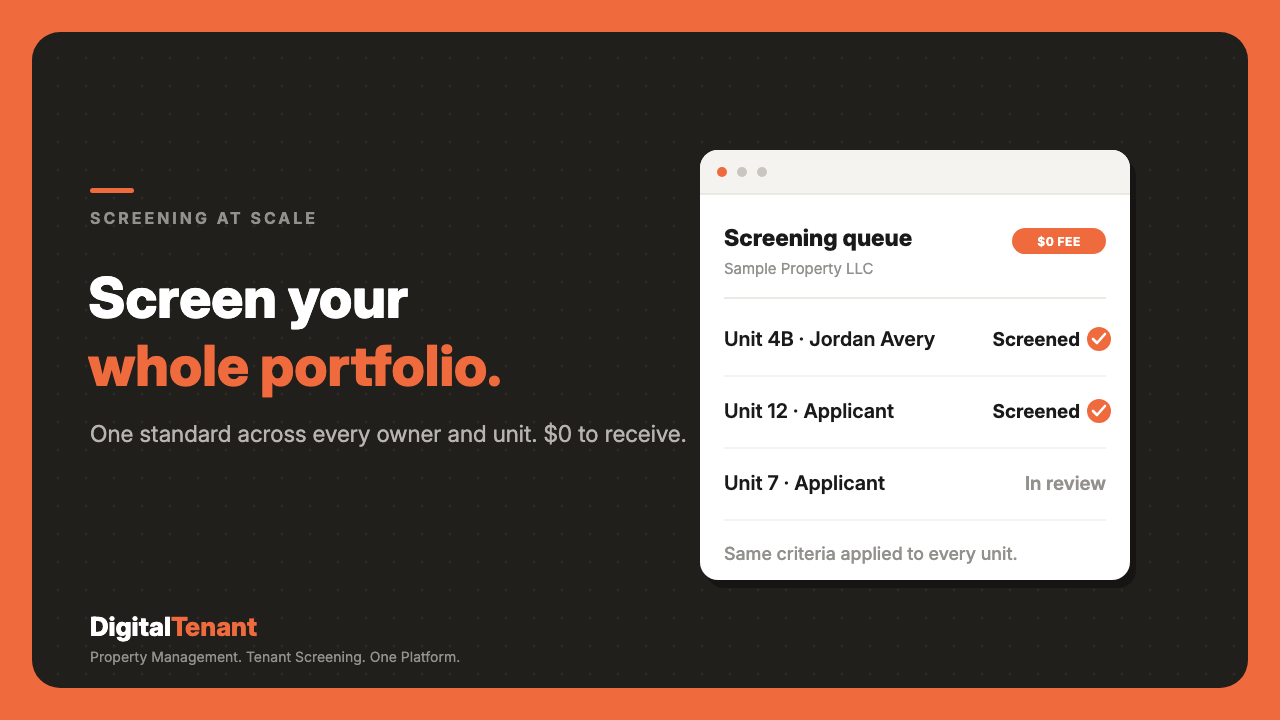
Here is the part landlords tend to miss. Receiving a Tenant Passport costs you nothing. Landlords and property managers pay no fee to receive or view a Passport, because the tenant pays for their own screening. You get a complete, verified report in hand without paying for the pull yourself.
If you want to see how this looks from the owner's side, our landlord and property manager screening page walks through the same TransUnion and Plaid checks landlords already trust.
What Colorado's HB23-1099 changes
Reusable screening only works if landlords will actually accept a report they did not order themselves. That is where the law comes in.
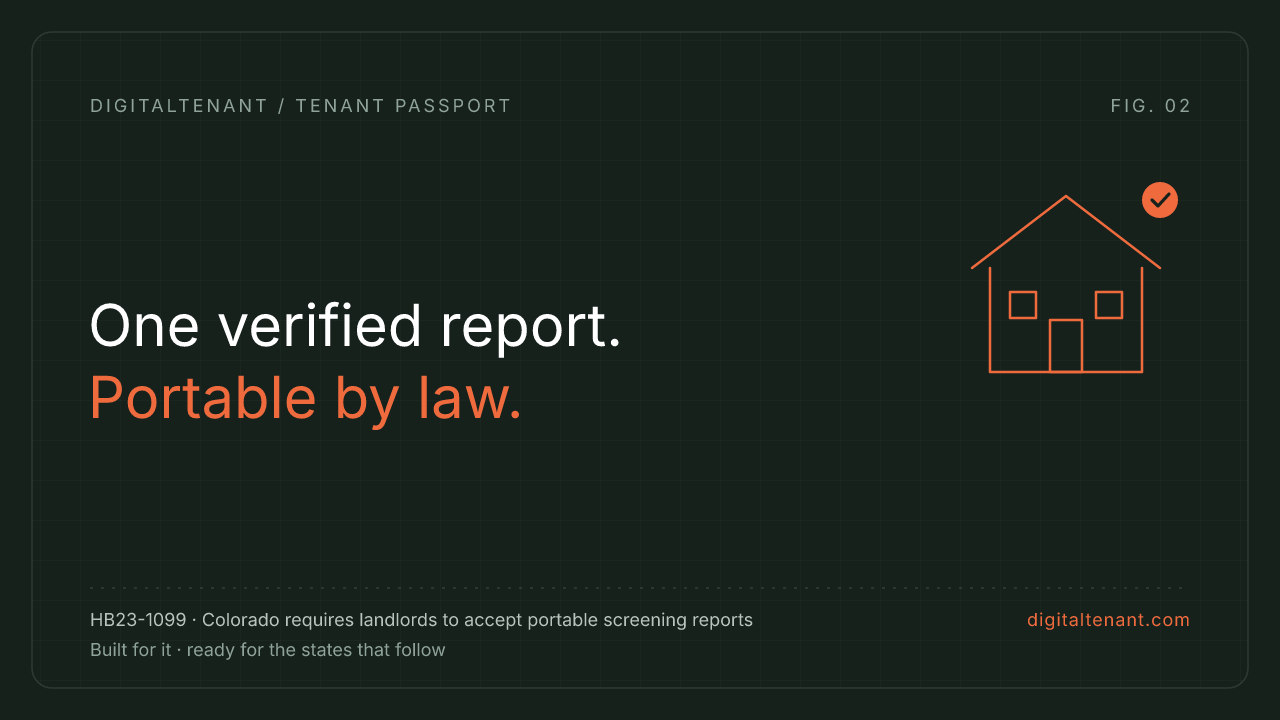
Colorado passed HB23-1099, which requires landlords to accept a portable tenant screening report rather than forcing every applicant to pay for a new one. In other words, the thing that makes portable screening fair to renters is no longer just a nice idea. In Colorado it is the rule.
There is one exemption. If you only take one application fee at a time for a unit, and you refund it in full within 20 days when either side declines, you don't have to accept portable reports. In practice that means screening applicants one by one while the unit sits empty, which is why most landlords accept them.
The Tenant Passport is purpose-built for exactly this. It produces the kind of standardized, verified, portable report the law is built around, and it is ready for the other states moving the same direction. Application-fee scrutiny and portable-screening rules are spreading, because the repeat-fee model is hard to defend once people see the math.
To be clear, you do not need to live in Colorado for any of this to help you. DigitalTenant is available nationwide, the Tenant Passport works for renters and landlords anywhere in the United States, and the case for reusing one solid screening is the same in every market. The law simply made Colorado first.
 Key Takeaways
- Portable tenant screening means one verified report the renter owns and reuses, instead of a new paid check at every application.
- Repeat application fees, around $55 each, punish the most reliable renters and rarely buy them anything they keep.
- For landlords, the old screening step is slow and pushes good applicants out of the funnel, which means more vacancy days.
- A full report checks credit, background, and eviction through TransUnion, plus identity and income through Plaid. None of that changes between listings.
- The Tenant Passport turns that one screening into a reusable proof, and Colorado's HB23-1099 requires most landlords to accept it.
- Landlords and property managers pay no fee to receive a Tenant Passport. The tenant pays for their own screening.
- DigitalTenant's Passport goes beyond standard portable screening. It adds employment verification, rental history, basic security questions, and supporting income documentation.
Next Steps
- Renters: create a Tenant Passport, get screened once, and stop paying to prove the same thing at every door.
- Landlords: start accepting portable reports, and pull qualified applicants through faster.
- Compare plans on our pricing guide. Property Lite is free for up to three units, so you can start without a card.
- Try DigitalTenant Free and see how one verified screening moves a good applicant into a lease.
Tenant Passport — Prove you're a good tenant once. Use it everywhere.
About the Author
Pierre Elize, Founder of DigitalTenant. Property Management. Tenant Screening. One Platform.
With Tenant Passport, applicants bring one screening report they can reuse, and screening costs landlords nothing.
Guides for landlords on screening, leases, rent and maintenance.