Introduction
Should landlords require renters insurance? In most cases, yes. It protects both sides: it covers the tenant's belongings and their liability, which your landlord policy doesn't. Most states let you require it in the lease, but a few set rules on how, so check yours first. I run my own rentals, and here's how I see it. When a tenant's kitchen fire damages the unit next door, I want a policy other than mine answering the phone. Here's how to think it through, set it up, and check it.
Why Should Landlords Require Renters Insurance?
Because your policy stops at your building and your liability. Your landlord policy covers the structure and you. It does not cover your tenant's stuff, and it does not protect your tenant if they cause damage or someone gets hurt in their unit.
According to the NAIC, a renters policy usually does three things:
- Personal property. Pays to repair or replace the tenant's belongings if they're damaged, destroyed, or stolen.
- Liability. Protects the tenant if a guest is injured in the unit or the tenant accidentally damages someone else's property.
- Additional living expenses. Helps cover the extra cost of living somewhere else if the unit can't be lived in after a covered loss.
That liability piece is the one that matters most to you. When a tenant's mistake floods the unit below, their policy can respond instead of the whole thing turning into a fight over your deductible and their security deposit.
There's a gap to close, too. In the 2020 Triple-I Consumer Poll, 57% of renters said they had renters insurance, up from 42% in 2018. That still leaves a lot of renters with no coverage unless the lease asks for it.
Renters Insurance vs Your Landlord Policy
Here's the split, plain and simple:
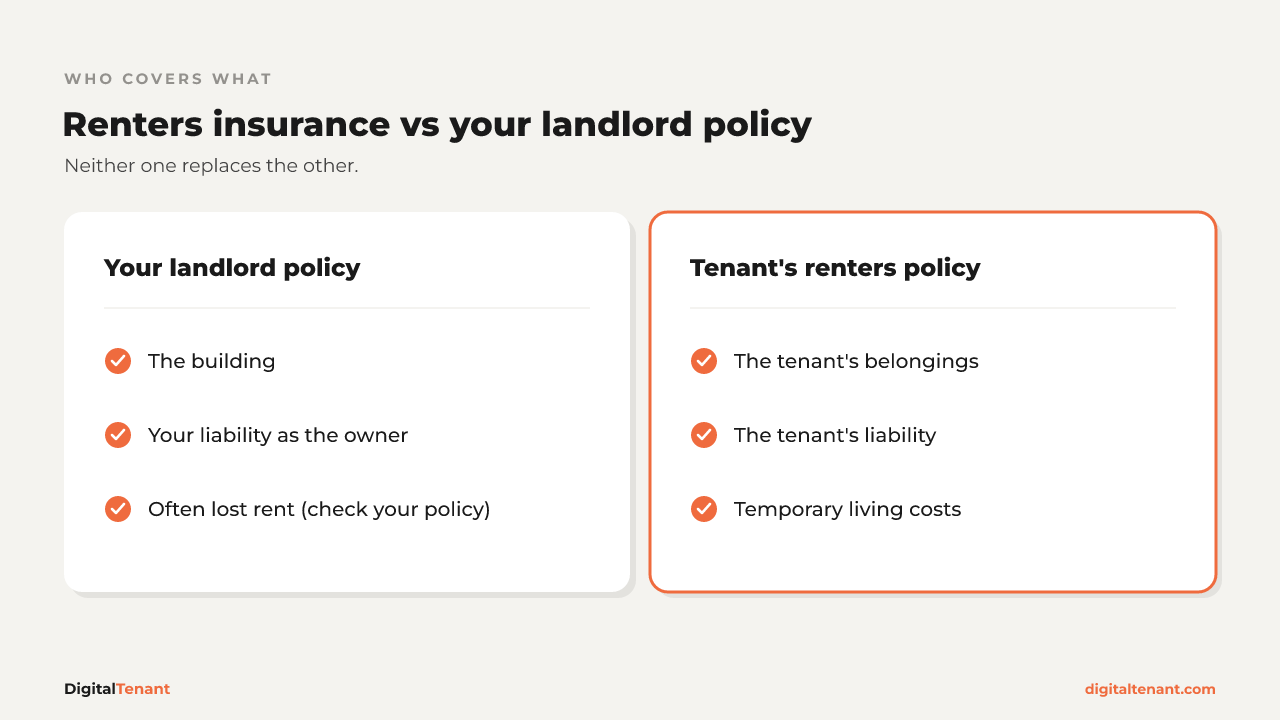
- Your landlord policy: the building, your liability as the owner, and often lost rent after a covered loss, depending on your policy.
- The tenant's renters policy: the tenant's belongings, the tenant's liability, and the tenant's temporary living costs.
Neither one replaces the other. Requiring renters insurance doesn't mean you can drop or cut your own coverage. Ask your agent what your policy actually covers before you write the lease clause.
Is It Legal to Require Renters Insurance?
In most of the US, yes, as long as it's written into the lease and applied the same way to every tenant. But it varies by state, and some cities add their own rules. Two examples show how different it can get:
- Virginia lets a landlord require renters insurance as a condition of tenancy, as spelled out in the rental agreement. The landlord has to tell the tenant in writing that they can get their own policy (Va. Code 55.1-1206).
- Oregon allows a liability insurance requirement with limits. Landlords can't require it from households at or below 50% of area median income or in certain subsidized units. The required coverage can't exceed $100,000 per occurrence or the customary amount for similar properties, whichever is greater. The landlord can't require a specific insurer, and can only be listed as an "interested party," not an additional insured (ORS 90.222).
So before you add the clause, check your state's landlord-tenant law and any local rules. This is general information, not legal advice.
⚠️ Common Mistake: Requiring renters insurance from some tenants and not others. Put it in every lease at the property, or none. Uneven rules invite fair housing problems.
How to Require Renters Insurance in Your Lease
Keep the clause short and specific. It should say:
- Coverage is required for the full lease term, starting on move-in day.
- The minimum liability limit, for example $100,000, where your state allows it.
- Proof is due before keys are handed over, and again at each renewal.
- You're listed as an interested party, so the insurer tells you if the policy lapses or is canceled.
- The tenant picks the insurer. Don't require a specific company.
- What happens if it lapses, such as a deadline to fix it.
Add the clause to your own lease document once and reuse that lease for every new tenant. With digital leasing, you upload your own lease and send it for e-signature. See how that works on our digital leasing page.
How to Verify a Tenant's Renters Insurance
A requirement you never check is just a sentence in a lease. Here's how to verify it:
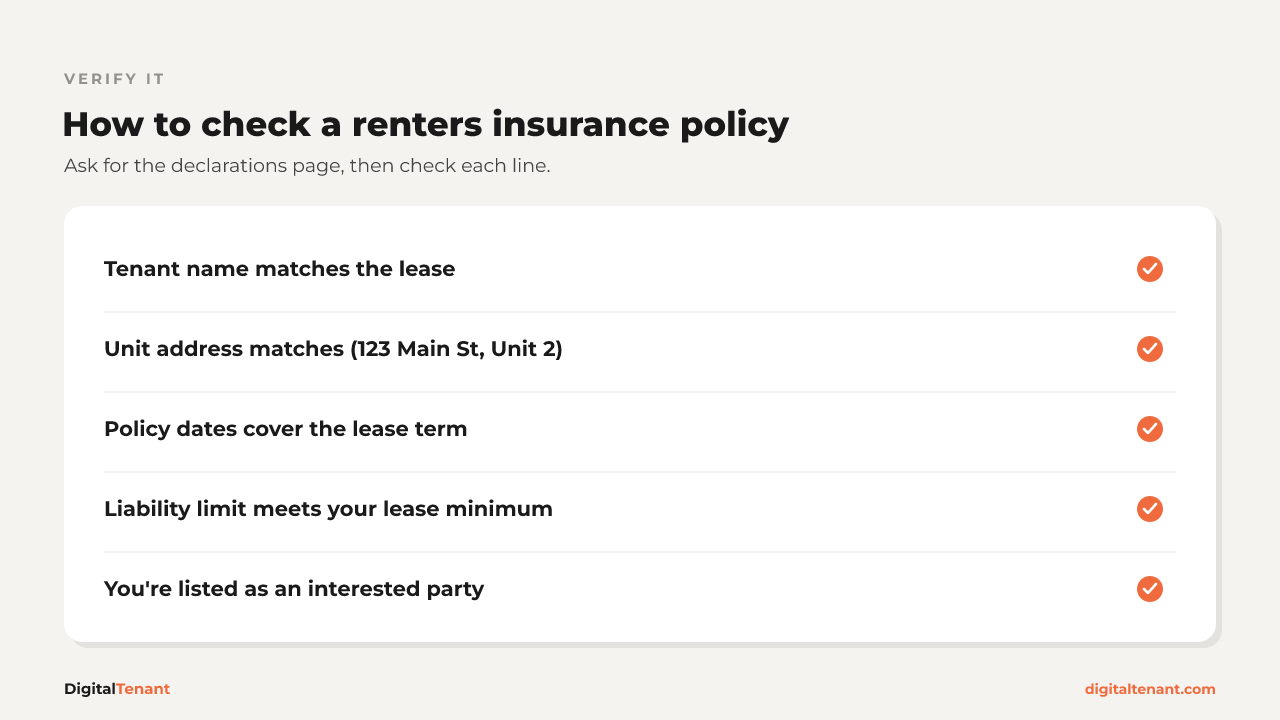
- Ask for the declarations page, not a screenshot of an app. It shows the tenant's name, the unit address, policy dates, and the liability limit.
- Match the address. "123 Main St, Unit 2" should be on the policy, not the tenant's last apartment.
- Check the dates. Note the expiration date and ask for the renewal before it passes.
- Confirm you're the interested party. That's how you hear about a cancellation.
💡 Pro Tip: Put each policy's expiration date next to the lease end date. Checking insurance at renewal time means you only look once a year.
How DigitalTenant Helps
Two pieces make this easier.
First, tenants can buy renters insurance through our partner Sure, right in the tenant portal. Tenant accounts are free, and the policy is the tenant's choice. Sure is one option, not a requirement, so a tenant like Jordan Avery can bring a policy from any insurer.
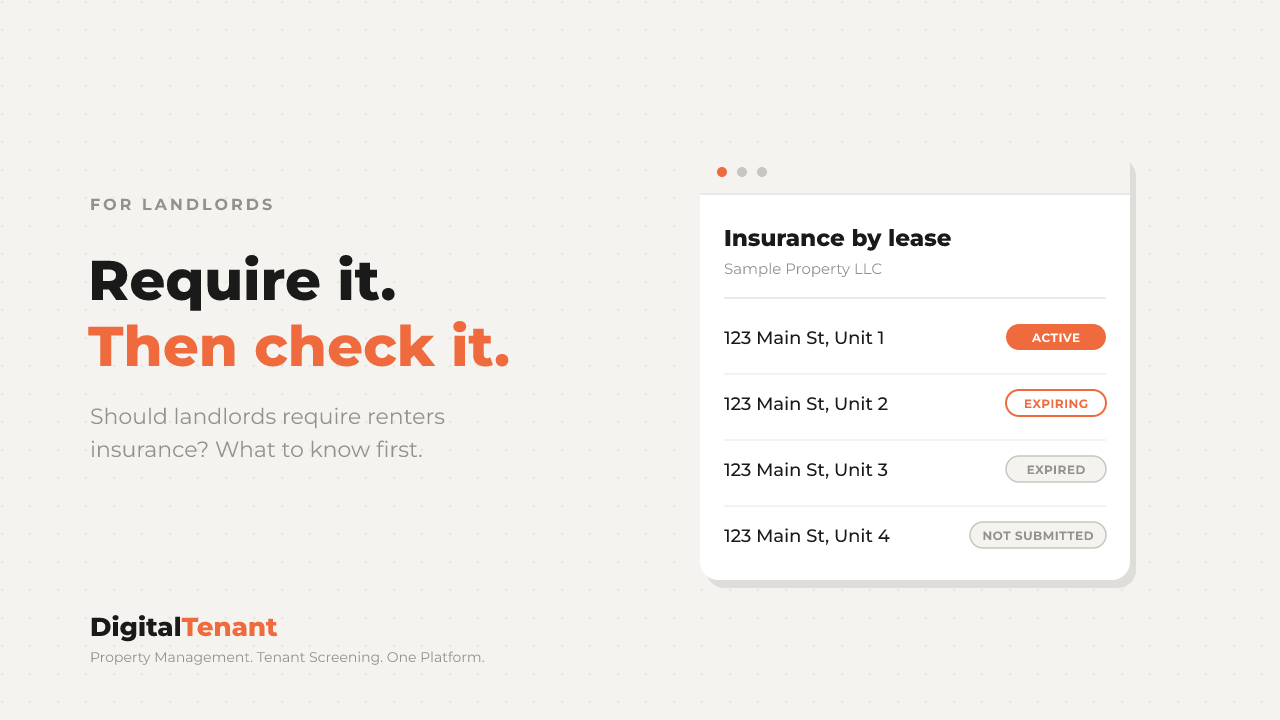
Second, the Compliance report gives you an insurance summary by lease: active, expiring, expired, or not submitted. Instead of digging through emails at Sample Property LLC to see who sent proof, you see every lease at a glance and follow up on the ones that need it. It's one of the built-in reports, exportable to PDF or Excel. See all the plans on our pricing guide.
Renters Insurance FAQ
Can a landlord require renters insurance?
In most states, yes, if it's in the lease and applied to every tenant. Some states, like Oregon, set limits on who you can require it from and how much coverage you can ask for.
Can I make the tenant buy from a specific company?
Usually you shouldn't, and in states like Oregon you can't. Set the minimum coverage and let the tenant choose the insurer.
Does my landlord policy cover my tenant's belongings?
No. Your policy covers the building and your liability. The tenant's belongings and liability need a renters policy.
What if a tenant's policy lapses?
Your lease should say what happens. Being listed as an interested party means the insurer notifies you, so you can follow up before it becomes a problem.
Key Takeaways
- Should landlords require renters insurance? In most cases, yes. It covers the tenant's belongings and liability, which your landlord policy doesn't.
- In the 2020 Triple-I Consumer Poll, 57% of renters had renters insurance, so many won't have it unless the lease asks.
- Legality varies by state and some cities. Virginia and Oregon both allow it, with different rules.
- Write a short, specific clause, apply it to every tenant, and let the tenant pick the insurer.
- Verify with the declarations page, and track who's active, expiring, expired, or not submitted.
Conclusion
Requiring renters insurance is a simple way to protect your doors and your tenants at the same time. Check your state's rules, write a clear clause, and actually check the proof. A requirement nobody checks doesn't protect anyone.
Next Steps
- Look up your state's landlord-tenant law and any local rules on renters insurance.
- Ask your insurance agent what your landlord policy covers and what it doesn't.
- Add a renters insurance clause to your lease template.
- Collect a declarations page from each current tenant and note the expiration dates.
- Try DigitalTenant Free and track insurance status for every lease in one report.
About the Author
Pierre Elize, Founder of DigitalTenant. Property Management. Tenant Screening. One Platform.
Free calculators for cash flow, vacancy cost, rent increases and more. No sign-up needed.
Guides for landlords on screening, leases, rent and maintenance.